24th July 2025
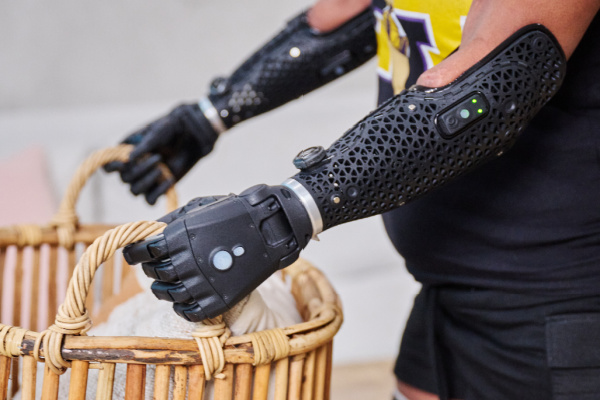
ABC Certified Prosthetist Jonah, who leads the Open Bionics clinic in Illinois, offers his expert perspective on what prosthetic weight really means in everyday life.
When people first start looking into upper limb prosthetics — whether it’s a bionic hand or arm — one of the first questions they ask is: “How heavy is it?” It sounds like a simple question — just look at the specs and find the number, right? But the truth is, the “weight” of a prosthesis depends on far more than the number on the scale. A lot comes down to the user’s age and strength, limb length and muscle tone, balance of weight,
and how well the socket and suspension system fit.
“
Some people hear “lightweight” and think “fragile,” but smart design uses strong materials in high-stress areas while trimming weight where possible. The result is a device that’s light enough to wear comfortably but strong enough for real life — opening doors, carrying bags, working outside, or playing in the rain.
”
Physical Weight vs. How It Feels
Take an example: a multi-grip prosthetic hand might weigh around 1.2 pounds. For an adult with good muscle tone and a well-fitted socket, that can feel surprisingly light. But for a child, or someone with a shorter residual limb, that exact same hand can feel much heavier if the weight isn’t balanced well. I like to explain it with a simple analogy: think about a broom. If you hold a broom close to the head, it feels easy to lift. But if you try to hold it at the very end of the handle, suddenly it feels much heavier — even though the broom’s weight hasn’t changed at all. A longer residual limb works the same way. If your limb is longer, the myoelectric hand is closer to your body’s pivot point, so it feels lighter. But if your limb is shorter, that weight is hanging further out, which makes it feel heavier to lift and use.


The Importance of Socket Design
As a prosthetist, I see every day how crucial good socket design is in managing this perceived weight. Using the right casting techniques, adjusting the shape, and choosing the best suspension system all help balance the weight and make the prosthesis feel more like an extension of the body — not something extra to drag around. Design decisions beyond the socket can make a major difference too. With the Hero PRO, for instance, the battery is integrated directly into the hand. This eliminates the need for external cables or forearm-mounted battery packs. Not only does this help streamline the look and feel of the device, it also reduces components that might otherwise get caught on clothing or make dressing more difficult. Integrating the battery into the hand supports a sleeker and more functional design — and it makes waterproofing the entire system possible. Despite housing the battery, the Hero PRO remains lighter than many comparable hands even before their batteries are included. So rather than having to shift weight toward the elbow for balance, this design keeps things simple while still feeling lightweight and natural to wear.
Materials Matter Too
Modern materials have helped a lot. Instead of bulky metal parts, newer devices like the Hero PRO and Hero RGD use lightweight 3D printed parts, strong composites, and titanium where it’s needed most. Each material has its time and place, but thoughtful engineering can make all the difference. For example, the Hero Flex socket uses a ventilated design and less material overall, which improves breathability while reducing bulk. It’s one of several ways prosthetic design is evolving to support long-term comfort and wearability. Some people hear “lightweight” and think “fragile,” but smart design uses strong materials in high-stress areas while trimming weight where possible. The result is a device that’s light
enough to wear comfortably but strong enough for real life — opening doors, carrying bags, working outside, or playing in the rain.
The Bottom Line
So, how heavy is a prosthetic? Most multi-grip bionic hands today weigh somewhere between 1 and 1.5 pounds. But the real measure is how it feels on the person wearing it — whether it’s balanced, comfortable, and strong enough that they hardly notice it’s there. Good design isn’t just about making a prosthetic lighter — it’s about making it part of the person’s body, so they can focus on living life, not on lifting their arm.

If you’d like to demo our technology at our Illinois clinic—or any of our locations across the country—just register your interest and our team will connect you with your nearest clinic.

 English
  USA
USA  German