23rd March 2026

If your child has a limb difference, you have probably already spent time wondering what the right path forward looks like. Whether the difference was present from birth or came later, the questions that follow are similar: What options are available? When is the right time? What will actually help?
There are no universal answers. Every child is different, and the best path is shaped by their age, their goals, and what matters to them personally.
What this guide covers is what parents most often want to know: how modern bionic arms work for children, what to expect from the fitting process, and how families have experienced it firsthand.

Children are active, fast-growing, and hard on equipment. They learn through play, movement, and doing things with their hands. A device that slows them down, feels uncomfortable, or requires constant management tends to get abandoned. Research published in the Journal of the Pediatric Orthopaedic Society of North America confirms this: smaller, lighter, and more durable prosthetic components are among the most pressing needs in pediatric prosthetics, and comfort is one of the primary drivers of wear time.
Modern myoelectric arms for children address these needs differently than older devices did. The Hero Arm uses EMG sensors to detect small muscle signals from the residual limb, translating them into finger movement and grip. The device is 3D-printed to fit each child’s individual anatomy, with a soft inner liner and ventilation built into the socket to keep it comfortable through active days. Most children learn to control it quickly, and with guidance from a clinical team, muscle control becomes intuitive.
“I can’t stress enough how important comfort is,” said Lucas, a Hero Arm user who later upgraded to the Hero PRO. “I know from my own experience that if something doesn’t feel right, you just won’t wear it.”
Lucas, Hero PRO userOne Hero Arm user, now wearing the Hero PRO, also reflected on what he wished had been available in childhood. “I remember wishing for that kind of precision when I was learning to ride a bike or carry a backpack,” Lucas said. “The control makes so many everyday tasks possible in a way older prosthetics could not.”
A prosthetic that fits well and feels like your own gets worn. One that does not, does not.
The Hero Arm is available for children from age five, making it one of very few multi-grip myoelectric bionic arms clinically approved for pediatric use. Clinical literature supports early prosthetic fitting where appropriate, noting that early introduction promotes motor skill development and reduces overuse in the non-affected limb. That said, readiness matters more than age. A child who is curious and engaged will get far more from the process than one who feels pushed into it.
Children who have adapted extensively to life without a prosthesis, as many congenital limb difference children do, may approach the device differently than those who experienced limb loss later. Both paths are valid. The fitting process at Open Bionics is designed to meet children where they are, with clinical teams who work exclusively in upper limb prosthetics and have experience with both presentations.
“Around age eight, independence suddenly matters so much,” said Lucas. “You’re figuring out school, sports, hanging out with friends, and discovering who you are.”
Lucas, Hero PRO userSigns your child may be ready to explore a bionic arm
None of these are requirements. A free consultation is the right place to explore whether the timing feels right for your family.
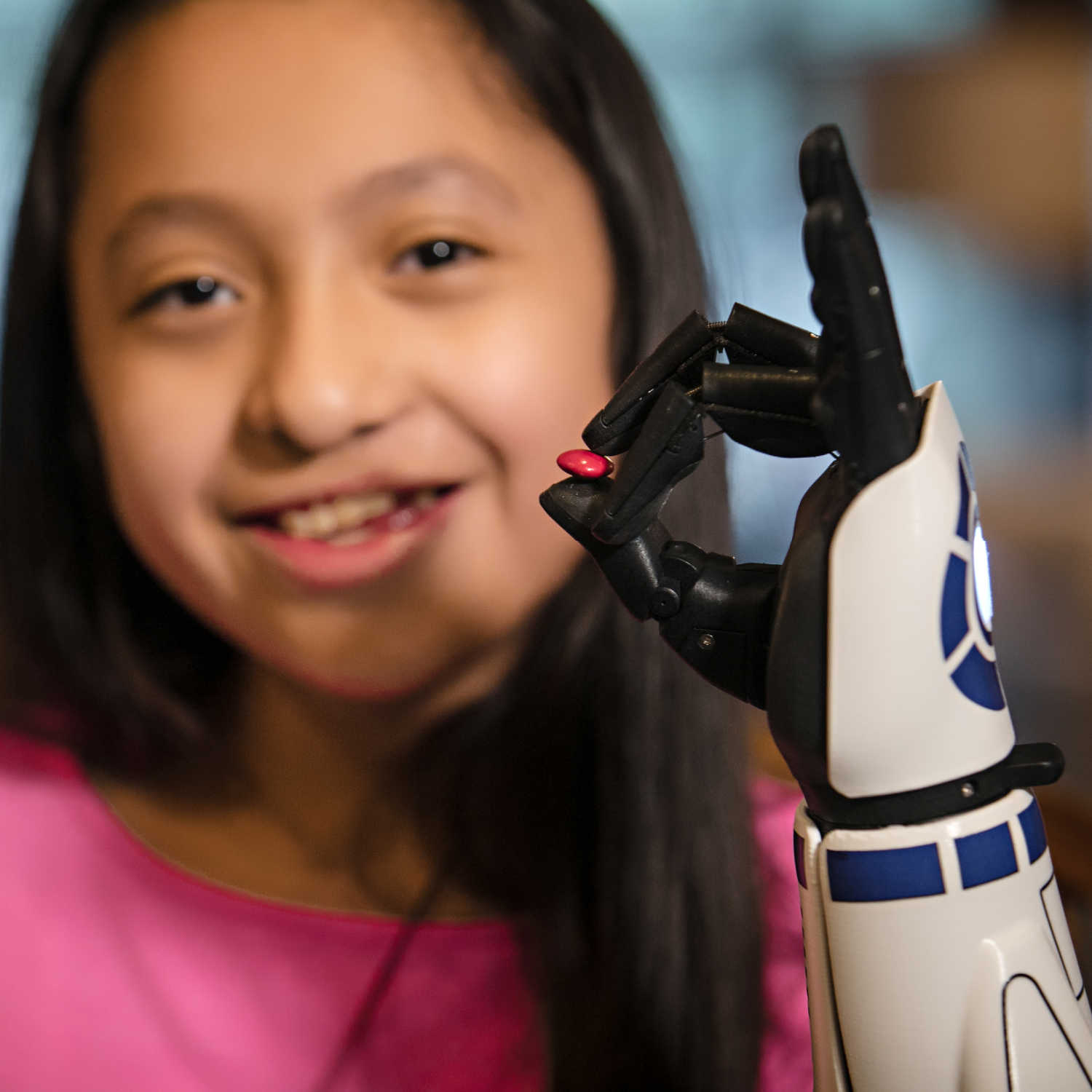
Research on pediatric prosthetics consistently points to psychosocial benefits as one of the most significant outcomes. A device that reflects a child’s personality, that they feel proud to show off rather than hide, changes how they carry themselves at school, with friends, and in new situations.
Daniel, whose daughter Phoebe was born with an upper limb difference, described the shift he witnessed after she received her Hero Arm.
Other children now, instead of asking “why does that girl have only one arm?”, are blown away with the amazing piece of equipment. This has increased Phoebe’s bubbly, zany character tenfold and provided her with a massive confidence boost. Open Bionics have not only supported Phoebe physically, they have helped her mentally with a lifetime of courage.
Daniel, parent of a Hero Arm userAlexander, whose daughter also received a Hero Arm, shared a similar observation.
Since my daughter has started using the arm she has started learning a lot of new things she can do, and it has given her so much confidence in everyday life. Thank you for making my daughter one step ahead of everyone else rather than one step back.
Alexander, parent of a Hero Arm user“Learning to embrace my limb difference was all about finding confidence in myself,” Lucas said. “The Hero Arm helps kids do the same thing while having a bit of fun at the same time.”
Lucas, Hero PRO userThe Hero Arm‘s magnetic covers let children personalize their device, choosing a look that fits their style. The option to make the arm part of their identity rather than something separate from it matters to children in ways that are hard to quantify but easy to see.
The journey to a first Hero Arm typically involves an initial consultation, a 3D scan of the residual limb, fabrication, a fitting appointment, and a delivery session that includes hands-on training. The process is designed to be straightforward for children and parents, with clinical staff who specialize exclusively in upper limb prosthetics.
Laura, whose six-year-old son received a Hero Arm, described the experience across multiple clinics.
Every step of the process, even Open Bionics’ help with getting insurance approval, was extremely smooth for us. It’s rare to have such a positive experience from beginning to end, and it’s clear this company puts their patients and families first.
Laura, parent of a Hero Arm userCarrie, whose daughter received her first bionic arm at the Illinois clinic, noted the importance of the ongoing relationship with the clinical team.
From the first phone call to the delivery of my daughter’s first bionic arm and everything in between, our prosthetist showed so much compassion for his patients and his work. We look forward to continuing this journey as she grows.
Carrie, parent of a Hero Arm userOccupational therapists often support children during the early training period, helping build muscle control and practice everyday tasks. The Sidekick App supports ongoing calibration and training at home, making it easier to build confidence between clinical appointments.
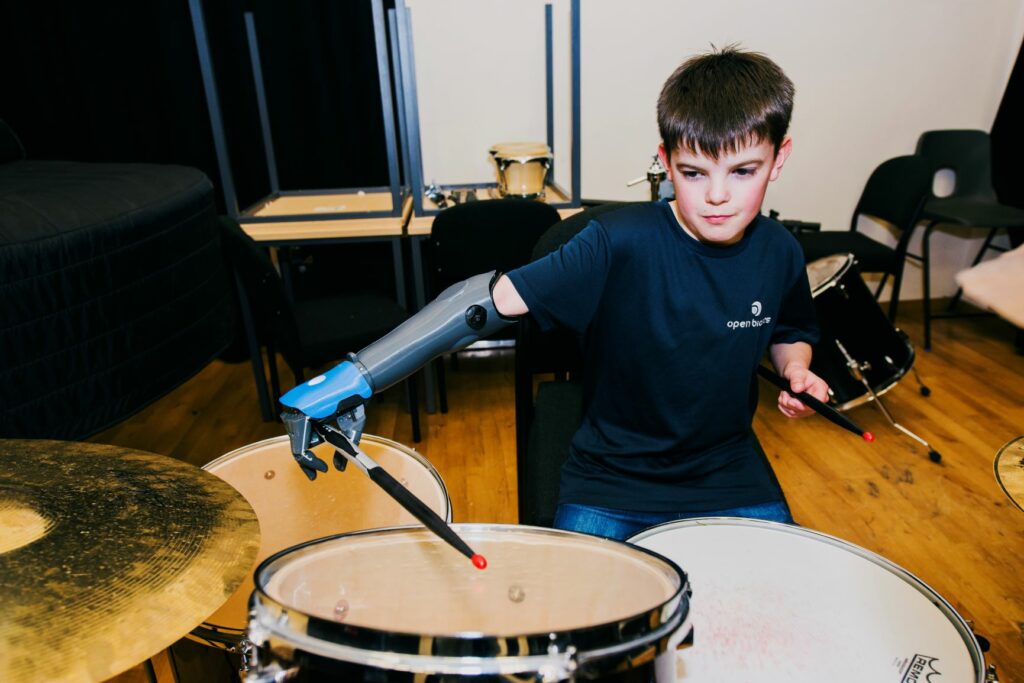
One of the most common questions parents ask is whether a bionic arm will keep up with an active child. The short answer is yes. The Hero Arm can lift up to 8 kg and weighs just over 300 grams. Children have used it for gymnastics, taekwondo, archery, cycling, and everyday school tasks. For older children who meet the size requirements, the Hero Flex socket connects to activity-specific attachments, allowing a single device to adapt across different activities. Your clinician will advise on which device is the right fit for your child’s size and presentation.
Kiowa, an eleven-year-old who received Hero Flex arms through the Open Bionics Los Angeles clinic, uses them for biking, riding horses, practicing taekwondo, and archery. His mother Nicole put it simply: “He’s always been capable. This just gives him more freedom to do what he loves.”
Clinical literature supports this picture. Research from the Journal of the Pediatric Orthopaedic Society of North America notes that most children are able to successfully participate in a variety of recreational activities, including sports and music, while using their prostheses. Activity-specific prosthetic options have expanded significantly over the past decade, giving children more ways to participate fully in the things they enjoy.
As children grow, devices are refitted and updated. The clinical team at Open Bionics supports families through those transitions, which is part of why the relationship with a prosthetist matters as much as the device itself.
Every child’s path is different. Some families come in with a clear idea of what they want. Others are still figuring out whether a bionic arm is the right step at all. Both are the right place to start a conversation.
Open Bionics operates specialist upper limb clinics across the United States. Consultations are free, and the clinical team works with families through the insurance process, the fitting, the training, and the long-term follow-up. If you are ready to find out what is possible for your child, a free consultation with an Open Bionics clinician is the starting point.
Speak with an Open Bionics clinician at no cost. We work with families through every step, from the first conversation to long-term follow-up.
Book a free consultation


