10th November 2025

My name is Lucas. I am a statistic. I am one out of the over 2 million people living with limb loss in the United States. I am also one out of over 1.7 million people in the United States who uses a prosthetic device. Of those 1.7 million, nearly 29% faced a prior authorization insurance denial for a prosthesis in 2023. Like many others, I’ve had to ask the question, does insurance cover bionic arms? This is my story on attempting to upgrade my arm prosthesis, a tool that is available to help millions of people live adaptive lives. However, what I really mean is gate-kept. This is a constant problem brought upon by the United States Healthcare System. All too often, the limb different community has no ally in insurers to receive the care they need just to tie shoes, open doors, cook in the kitchen, or hold their child. It must end.
I was born without my right arm below the elbow. This is a congenital amputation. Technology in the early 90’s was unable to detect this, though I was born happy and healthy and my family was as excited as ever to welcome me into the world. Early on in my adolescence, my parents found support and resources to accommodate my limb loss through Shriners Hospitals for Children, a nationwide children’s hospital specializing in care for children with differences like mine, completely free.
When I was about three years old, Shriners provided me with my first prosthetic arm; a passive device with no function. This arm prosthesis was designed to give me a natural or normal appearance. I recall conversations with my mother where she shared I was not particularly fond of it, nor would my parents force me to wear it. After all, it served no real purpose but to make others comfortable around my limb difference.
As I grew, Shriners continued to provide arm prosthetics for me, and they became more useful. Between the ages of six and 21, I was fit with body-powered prosthetics with a shoulder strap. This type of prosthesis was limited in function, though it still allowed me to do some two-handed tasks, despite struggle and pain. Over time, I became more exposed to advancements in technology and began to view the body powered prosthesis as inferior, something that was trying too hard to look like a real hand with a skin toned color. While at the same time, limiting my dexterity and further damaging my back due to overexertion. I recall one dangerous instance in school where I was climbing on a dome playset and fell through, with my prosthesis catching on a bar and leaving me hanging from the playset, fighting to break free.
“
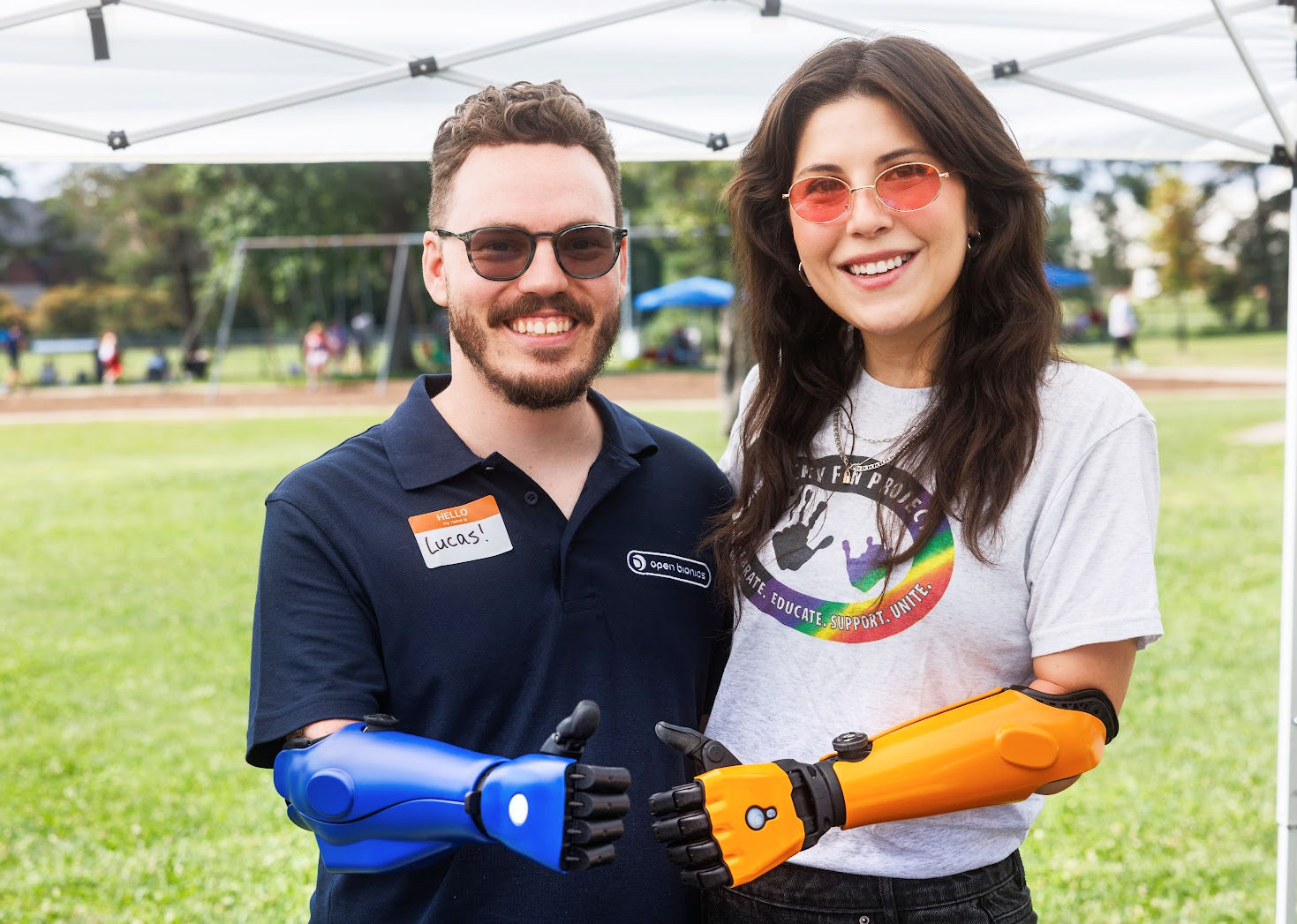
For five years, my life has been vastly improved by the Hero Arm, in both its function and in terms of emotional well-being and confidence. The Hero Arm was light, comfortable to wear, intuitive, and stylized. It looked cool, which allowed me to express myself and feel good about the device I was using.
”
I transitioned to my first myoelectric prosthesis in 2014 with what would be my last free prosthesis with Shriners. This prosthesis used technology to detect electrical signals within my arm muscles to open and close the hand in one grip. One may think this technology sounds like something out of the future, but it actually dates back to the 1950’s. Though more advanced than the body-powered arm, this myoelectric was extremely heavy, had limited grip use, and the socket was very uncomfortable. For this reason, my use of the first myoelectric prosthesis was short-lived and my search continued.
Unfortunately, this time I had aged out of the Shriners program, aged out of my parents insurance coverage, and faced the daunting obstacle that is healthcare coverage. It seemed that no matter what job I held, arm prosthesis coverage was locked away to full time employees or just not an option within the plans I had at the time. I recall simply being told “no” by a previous supervisor on a request for full time employment over part time, as a full time employee with that company had access to 100% coverage for prosthetic devices. This was explained to them and ignored. In that instance, my supervisor held authority over my access to a limb, which is unacceptable. I am not afraid to point out that this employer was Kent State University. I should’ve escalated this issue to their department of disability inclusion, but alas, I felt too defeated.
I attempted to receive my next prosthesis, the Hero Arm by Open Bionics, during COVID-19. At the time, I was a part time employee with Chipotle Mexican Grill. Known for having limited insurance benefits, I figured my attempt to gain prosthesis coverage was a long shot. I ended up being correct. My insurance gave me conflicting and contradictory information on durable medical equipment coverage (most prosthetics fall under this umbrella), and was ultimately ignored upon multiple follow ups. I then turned to GoFundMe and was able to raise over $11,000 to receive the Hero Arm. This is a systemic failure. GoFundMe is not healthcare, and though I was grateful to have succeeded, too many campaigns through charitable means lay dormant or gain no traction. In no instance should the limb different community have to rely on this avenue to receive the tools they need to live their lives the same way as others with all of their limbs.
Check out Lucas talking about his Hero Arm when he was fitted back in 2019.
For five years, my life has been vastly improved by the Hero Arm, in both its function and in terms of emotional well-being and confidence. The Hero Arm was light, comfortable to wear, intuitive, and stylized. It looked cool, which allowed me to express myself and feel good about the device I was using. It made me feel proud and accepting of who I am. It also gave me an opportunity to have more educational and positive discussions on prosthetics and limb differences with curious people.
In early 2025, Open Bionics launched the next generation of the Hero Arm, the Hero PRO. A tremendous upgrade from its predecessor, the Hero PRO came with water resistance, touch screen compatibility, wireless sensors, an internal battery, and a manual flex wrist. It was the upgrade I was looking for to further my journey of adaptability. This time, I had better insurance (so I thought), and I was much more confident that I wouldn’t face the same hurdles as before. I had grown into a seasoned prosthetic user, surely insurance would see the necessity, right? Wrong.
Upon checking my new insurance plan for prosthesis coverage, I learned that it would be covered, though only with a pre-authorization and out of pocket cost. Pre-authorization means that I would need to have a prosthetist and a primary care physician submit documentation as to why this prosthesis would be suitable for my use. I set up an appointment with my primary care physician to make it happen. Luckily, appointment availability was soon, which is not always the case, further delaying the entire process. This meeting was extremely awkward. As I sat in the clinic room, I realized I was telling a complete stranger the rationale for having two arms. It felt silly and uncomfortable to sit there and say “I need this arm to tie my shoes, to cut food safely, to do dishes without hurting my back, to use my phone and type on my work computer at the same time.”
Despite this, my doctor was completely supportive and signed off on my need for the Hero PRO. It’s important to point out that this is not always the result. All too often, people with a limb difference face pushback from a primary care physician. They feel it’s not needed or not helpful. I say: the doctor isn’t the one wearing or using the prosthetic, so who are they to dictate the tools we desire to make our lives more accessible. We need the care team on our side. I was lucky in that regard.
After submitting pre-authorization to insurance, a denial was given less than a week later. Justification for the denial was based upon the following:
The insurance company stated that the above criteria was not met. This proved to me that no one actually read my pre-authorization, as all of this information, rationale, and proof was submitted. It’s clear that someone who lacks knowledge of prosthetics simply denied it based purely on the intention of saving money. Mind you, the same company reported a consolidated operating revenue of $175.2 billion in 2024. Do not tell me you cannot afford the prosthesis.
Not only was I surprised by this decision, I was disgusted. No one took the time to read why I needed a new arm prosthesis, despite clearly having the funds to cover it. After metaphorically licking my wounds, it was back to the drawing board to file an appeal of the denial. With the help of my prosthetist, I was able to write an appeal complete with documented proof that their requirements for approval were met in the initial submission. I am missing my arm. I am able to operate prosthetics. A standard device did not meet my needs. Documentation of my muscle control of the Hero Arm was given, showing proper “electrical voltage”, as insurance put it. It was all there.
The next issue I faced was obtaining a co-signature from my primary care physician, which was necessary to strengthen my case for appeal approval. Despite numerous attempts by my prosthetist to get this signature, it wasn’t received until I actually had to go there in person and ask for it. Surprisingly, the document needed was sitting in their files, complete. The problem was no one was doing anything with it. How long would it have sat there without my involvement to expedite the process? This is another systemic failure on the part of some doctor’s teams. They simply do not see the urgency behind the limb different communities need for these devices. They become another unnecessary roadblock that only slows the process and makes the journey towards obtaining a prosthesis even longer. Even more, some insurance policies require an appeal be filed within a 30 or 60 day time span, depending on the policy. Patients are in a race against time.
Shortly after submitting the appeal, I decided to check on the forms progress through my insurance portal online. I found that the appeal authorization had been received and under review, which was a promising step. A few days later, I checked again. This time, the appeal authorization had a status of “authorization cancelled.” I did not know what this meant, as it’s typical for status’ to read as either approved or denied. In addition, I received no phone call or email that an update had occurred, so I found this information out purely on my own. I decided to inquire with my prosthetist what this meant, to which they were unaware. My prosthetist decided to give them a call, where they were placed at 107 in line to speak to a representative. These steps are troubling. I think of the many amputees who do not have access to a computer, phone, or the internet to check on these status updates in a timely manner.
I’ve included the discussion with the insurance rep re the cancellation issue below. This is an ongoing concern among the limb different community with getting answers regarding our care, too many insurance reps just do not know or have no clear answers to provide, which leads to us giving up. Make no mistake, this is what they count on. An extremely important piece of advice to all amputees communicating with insurance: document everything. Gather names, dates, descriptions of conversations, everything. This strengthens your case and loads you with the proof you need in case you are rebuked by insurance.

After relaying this information back to my prosthetist, they attempted to inquire again as to the cancellation debacle, and were told, quote: “They had received duplicate appeal requests as to why the one you see shows as cancelled. The one that was submitted on 4/30/2025 is the one that is in review and the turn around time is until 5/30/2025.”
Weeks went by with no updates and I was left wondering and anxious. The deadline for the appeal decision came on May 30 and it was again denied. The appeal was denied for the same reason, “not medically necessary.” Interestingly, the denial referenced a policy outlining their definition of a prosthesis not medically necessary, the Luke/Deka prosthesis. This type of prosthesis and the Hero PRO are completely different. Someone, again, did not fully read what I was seeking and boxed the two into the same category.
Our next option was to submit the claim to an external appeal review within 60 days. This meant I needed to reconnect with my primary care doctor for more rationale as to why the prosthesis is needed. More time consuming hoops. By this point, I was extremely frustrated, emotionally drained, and ultimately discouraged about even continuing the process. Again, this is what the insurance system counts on.
In my external appeal, I clearly outlined the differences between the Hero PRO and the Luke arm, and explained how the Hero PRO is not medically considered an “enhanced dexterity prosthetic” as the insurance claim response called it, and therefore falls outside their policy of “not medically necessary.” I also decided to request my former Shriner’s occupational therapist contribute a letter of support, if only to strengthen my case. We submitted the external appeal at the end of June, and they told us to expect another decision by August.
Finally, in late July, the insurance company caved to the continuous pressure and the external appeal and updated us that the previous denial had been overturned and my Hero PRO approved. Upon reading this news, I felt an immense weight lift, as well as an extreme sense of victory over a system that is systematically designed to keep adaptive care out of the hands who need it. It brought me joyous vindication that, finally, someone actually took time to read the evidence that had been present all along in my initial authorization.
Though my battle has been won, the war is far from over. We cannot rest until the system is changed for the limb different community. Adaptive devices meant to increase quality of life cannot continue to be gatekept as they are. It will take continuous pressure and grassroots organization to bring about the change we need to see. My message to anyone going through a similar circumstance is this: never stop. Never be afraid to get loud and to advocate for what you deserve. You have a right to a limb. Continue to push back against anyone who tells you otherwise, no matter how big or how small the voice against you is. With loud and determined representatives in the limb different community, we can rewrite the rules and rebuild the corrupt system, one victory at a time.
In addition, once Open Bionics learned that my insurance had denied my Hero PRO, they quickly stepped in to offer support and pressure on my behalf. Open Bionics, as an employer of people with disabilities, did request a plan that covered prosthetics for their employees. When my insurance denied my claim, I informed HR who then reached out to them and threatened to pull their business if they could not honor their prosthesis provision policy. This advocation made me feel especially seen and supported.
Get in touch with us to talk through insurance coverage options, out-of-pocket costs, and funding support available to help you get your bionic arm.

 English
  USA
USA  German