2nd December 2025
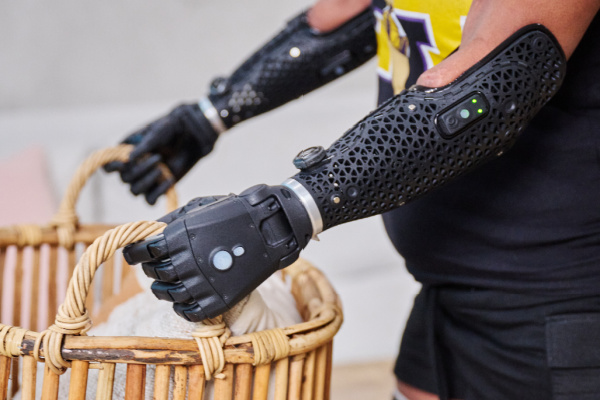
For ten years, our small engineering team has rebuilt the idea of what a 3D printed bionic arm can be. We prioritized user feedback, questioned old assumptions, and were willing to reinvent the bionic arm from scratch.
Most upper limb prosthetics look the way they do because the industry spent decades making only small adjustments. Silicone cosmetic limbs aimed to blend in and hide a limb difference. Body-powered devices relied on cables and harnesses that often caused overuse injuries. Heavy, expensive multigrip bionic hands were scarcely available and were shaped by longstanding assumptions rather than user needs.
We entered the prosthetics landscape with a different mindset.
Rather than copying existing devices, the early engineering team set out to build upper limb prosthetics that prioritized design freedom, comfort, accessibility, and expressive identity. From the beginning, the goal was to rethink what a 3D printed bionic arm could be rather than refine what already existed.
Few people witnessed this evolution more closely than engineer Olly McBride, who joined the founders while still in university. Over the next decade, Olly helped shape nearly every major technical breakthrough that followed. From early prototype designs and electronics to motor control systems, Bluetooth connectivity, evolving sensor technology, and the engineering tradeoffs required to make a bionic hand fast, lightweight, and durable without sacrificing battery life.
“We always had a strong sense of what we wanted to build,” Olly said, “but the engineering path to get there wasn’t obvious. A lot of the early work was just us trying things, breaking them and figuring it out as we went.”
Our earliest bionic hands were printed on hobbyist 3D printers, which was an emerging technology at the time. The first major prototype, the Dextrus Robotic Prosthetic Hand, looked nothing like our sleek, high-performance devices today. It was a fully 3D-printed device packed with motors, bearings, spools and wires. The Dextrus prototype was reminiscent of the Iron Man armor that Tony Stark pieced together in a cave, and less of a clinical device. It took nearly a full day to print and several more days to assemble, yet it proved something essential: a more accessible, expressive, engineered-from-scratch bionic arm was indeed possible.

Olly recalled modifying printers and experimenting with flexible 3D-printed materials. Our next prototypes were unlike anything else in prosthetics at the time. They featured rubbery, flesh-like printed surfaces, flexible joints and wired tendons with the tensile strength of shark fishing line. They could grip and release, but the flexible materials made them difficult to manufacture consistently. Components softened in extreme heat or slipped under heavy loads.

“We were learning what not to build as much as what could be built,” Olly said.

A major turning point arrived when we were selected for the Disney Techstars Accelerator. The goal was straightforward: “To step onto a bigger stage and show that prosthetics could be as expressive as they are functional,” Olly said. Inside the program, we built official Iron Man and Star Wars inspired prototypes with magnetic covers, rumble motors and light effects. These early designs were not yet product ready, but they proved that prosthetics could be expressive rather than disguised.


We continued refining the design through a collaboration with Eidos Montreal, creators of the Deus Ex video game. This partnership produced the Deus Ex bionic arm, which introduced slimmer mechanics, compact electronics and stronger 3D-printed components.


Rapid prototyping soon became our defining advantage. “We would give an early prototype arm to a user and check in every few days to see what had broken,” Olly said. “Then we would fix it and try again.” This fast cycle of testing and redesign led to our first major breakthrough: the Hero Arm.

The Hero Arm brought a wave of industry firsts. It introduced customizable covers in a field dominated by skin-colored prosthetics, and was made famous by first-of-its-kind licensing agreements with the likes of Disney. “We have been told by a lot of amputees that they want something that will get a compliment, not a strange stare,” said USA CEO and co-founder Samantha Payne.
Today, we offer the first officially licensed prosthetic covers inspired by Star Wars characters like BB-8 and R2-D2, Marvel’s Iron Man, Spider-Man, Deadpool and Wolverine, Disney’s Frozen and The Princess and the Frog, and Konami’s Metal Gear Solid. Additional collaborations include Eidos Montréal’s Deus Ex, James Cameron’s Alita: Battle Angel and Activision Blizzard’s Call of Duty.
The Hero Arm also offered wrist rotation as standard when many devices treated it as an add-on feature. It launched as the smallest and lightest multigrip bionic arm on the market, which made it possible for clinicians to fit younger users, including our first 5-year-old user, Jordan, who could comfortably manage the weight where other devices had been too heavy.
The breathable 3D-printed socket and open frame design was another industry first, allowing air to flow around the limb for greater comfort and longer wear. Durability also improved. Unlike earlier multigrip hands that required careful handling, we engineered the finger joints to flex with hyperextension rather than break.
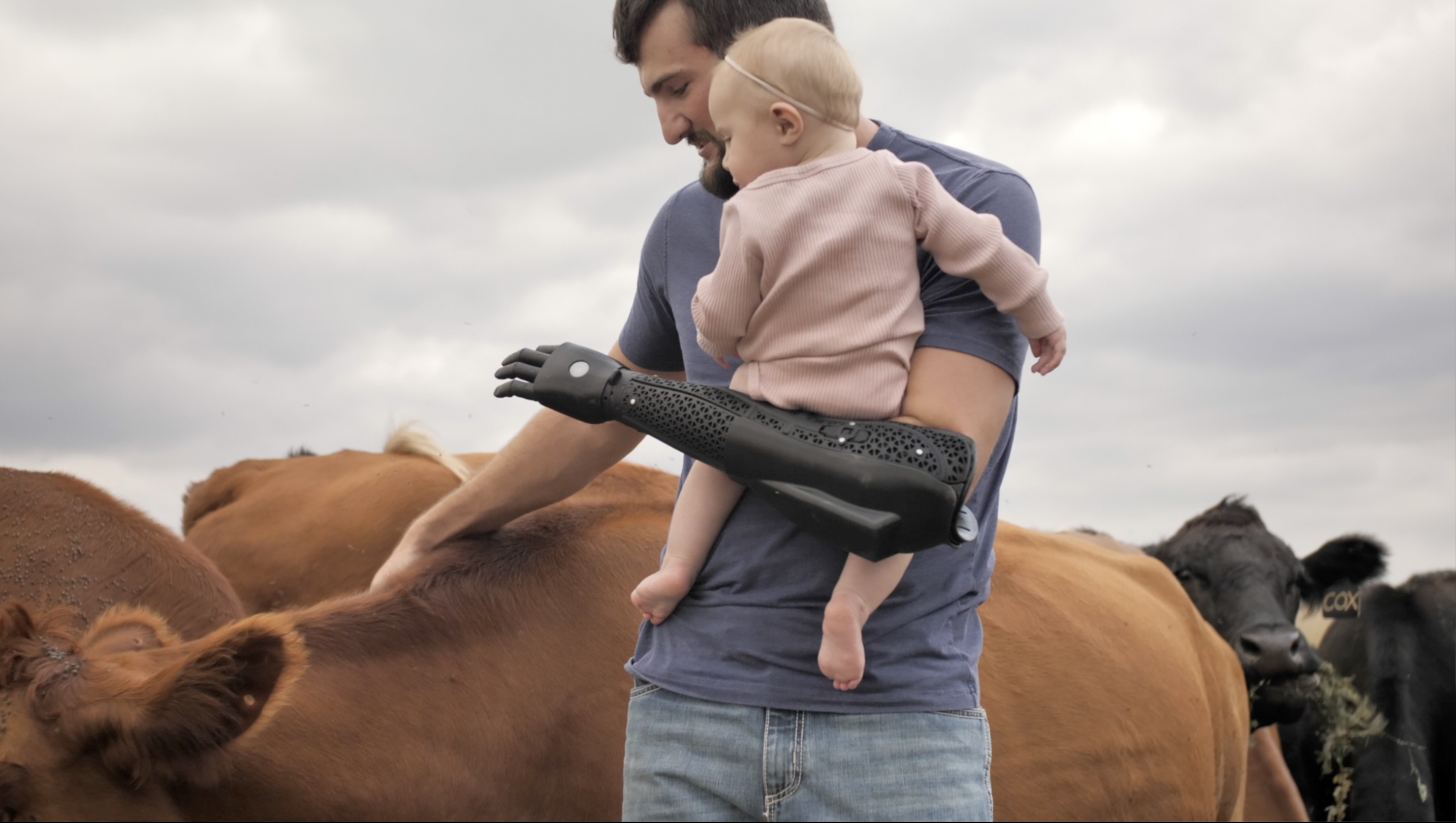
Because of these innovations, the Hero Arm became the first medically approved and insurance reimbursed 3D printed multigrip myoelectric arm, expanding access through clinical and insurer networks.

As access to the Hero Arm expanded through insurance, a new set of user priorities began to emerge with striking consistency. Adult users wanted a bionic hand that could get wet, a socket that felt lighter and more breathable, a more durable system that worked seamlessly with Activity Attachments, and clinical fittings that felt intuitive rather than technical. Incremental updates alone could not meet those expectations.
“If we had to start from scratch, what would we do?” Olly said. “That is the question that led us to redesign everything.” That question became the foundation of Hero PRO and Hero RGD, two devices built on engineering breakthroughs no other bionics company has been able to replicate.
Water resistance was one of the most common requests, but achieving it required a complete rethinking of the electronics architecture. To prevent leak paths, we eliminated all wiring outside the hand. Integrating the battery inside the hand removed the need for power cables. Replacing traditional wired electrodes with Bluetooth-enabled MyoPods removed the last remaining data lines. This created the first fully wireless multigrip bionic architecture and enabled a sealed system capable of true water resistance.
MyoPods also introduced a major industry first: a two-pad EMG sensor in a field that had relied on three-pad systems for decades. As Olly explained, “most manufacturers use that third pad to try and reject all of those noisy signals.” Our engineers approached the problem differently. “We use both pads to remove that noise,” he said. “We’ve got some very special electronics that make it so we don’t need three pads.” By solving noise rejection within the electronics rather than through an additional pad, the system became smaller, lighter, and fully wireless.
For clinicians, going wireless set a new industry standard. MyoPods can be placed directly on a patient’s skin to test muscle sites without cables or complex systems. EMG responses appear instantly in the Sidekick app, allowing clinicians and occupational therapists to fine-tune controls on the spot. What had once required a technical, multistep setup can now be a streamlined and more intuitive clinical visit.
A crucial part of the redesign was Hero FLEX, a breathable, water-safe socket system that also allows some long residual-limb users to retain some biological wrist rotation. Very few prosthetic systems offer similar biomechanical freedom of movement. By removing the need to route wires through the socket, Hero FLEX also made it possible to adopt a titanium and steel USMC-style wrist connector, expanding compatibility with a broad ecosystem of Activity Attachments.
“There are literally no wires in the wrist,” Olly said. “The hand just pops on and off, and you can put any bolt on there to connect it to any USMC system.” This structurally reinforced interface also enabled another first: Hero RGD is the only bionic hand capable of lifting up to 77 pounds.
Hero PRO and Hero RGD further advanced durability through military-grade steel, industrial 3D-printed Nylon PA12 components, clutched proximal joints that protect internal gears, and a fully powered articulating thumb. Both systems were engineered to be expressive, functional, lightweight, and built for everyday use.
Looking back on a decade of development, Olly summarized what motivates the work. “I never really understood how rewarding it would be,” he said. “It is not just a product that people buy for a bit of fun. This will play a major part in their lives.”
We were the first to mainstream expressive, swappable covers, the first to deliver lightweight open frame sockets, the first to integrate clinical grade 3D-printing into bionic arms, the first to create fully wireless multigrip hands, and the first to make waterproof bionic arms possible. We were also the first to introduce wireless two-pad EMG sensors, the first to pair modular sockets with wireless titanium wrist connectors, and the first to deliver lightweight bionic hands to children as young as five.
Each innovation began with an idea posed by Joel years ago. “Advances in technology have the power to change lives for the better. Creative innovators are very much needed to push for this.”
We have pushed, again and again, until the industry was forever changed. We can’t wait to show you what we do next.


