Jose wore a hook for 45 years before he tried on his Hero PRO, a bionic arm for upper-limb amputees developed from feedback from over a thousand users and built for comfort, durability, and precision tasks. What he found on his first fitting day surprised him.
Jose, 56, lost his right arm below the elbow in an electrical accident at age 11. He spent 28 years driving for a car service in New York before moving into airline operations. He now works for Delta Airlines at Raleigh-Durham International Airport, in a role that involves aircraft doors, baggage systems, and tight operational spaces where imprecise movement creates risk.
He used a hook to accomplish most of his work, but soon realized he needed a better tool for his job. “Sometimes I have to close the door of the plane,” he said. “With the hook I’m always afraid to touch it. With the arm, it’s easier just to get that push while I close the door.”
Baggage tagging presented a separate problem. When reaching to attach a tag to luggage, the movement pulled on his harness and caused the terminal device to open unexpectedly. He dropped the tag. Closing an aircraft door requires steady, distributed surface contact across a palm. A myoelectric hand with a conforming grip and adjustable wrist provided that reliably.
For most of his life, Jose assumed advanced prosthetic technology was financially out of reach. Insurance coverage for myoelectric devices is an ongoing challenge across the upper limb amputee community, and for years he had no reason to think his situation was any different.
The assumption shifted after a conversation with a regular Delta customer. “He told me to pursue it because they’re paying for this type of arm now,” Jose said. “One day I was browsing through Instagram and I saw a video of someone with a bionic arm and got interested. I’m like, let me check. Maybe I can get it.”
“
“One day I was browsing through Instagram and I saw a video of someone with a bionic arm and got interested. I’m like, ‘let me check. Maybe I can get it.'”
”
He looked into coverage, found it was possible, and moved forward with a consultation at the Open Bionics clinic in Charlotte, North Carolina.
A large number of experienced prosthesis users are making daily decisions based on outdated assumptions about what modern devices cost and how they are funded. Clinicians working with long-term patients have a real opportunity to correct that. The Amputee Coalition publishes funding guidance that can help patients understand their options before they rule anything out.
He looked into coverage, found it was possible, and moved forward with a consultation at the Open Bionics clinic in Charlotte, North Carolina.
A large number of experienced prosthesis users like Jorge make daily decisions based on outdated assumptions about what modern devices cost and how they are funded.
Jose came to his first fitting expecting difficulty. Transitioning from 45 years of body-powered use to myoelectric control is a genuine neurological adjustment. The muscle signals are different, the feedback loop is different, and the motor pattern has to be rebuilt.
His experience did not reflect that expectation. “It’s actually been easy,” he said. “I thought it was going to be harder, but it has been easy.”
Sensitivity and grip calibration were completed through the Sidekick app. Jose took to the wrist movement quickly, flexing and extending the hand to position it against surfaces with a level of control he had not had before.
Isabel Gonzalez, Jose’s certified prosthetist who fitted him at the Open Bionics clinic in Charlotte, said he stood out for using the full range of the device from the start. “A lot of people get their arm and put it on for the first time and they forget that the wrist moves,” she said. “They try doing everything bending their elbow, bending their shoulder. He’s getting it. He’s moving that wrist. He’s flexing and extending the hand already. He’s using it to the fullest.”

Jose chose red covers for his Hero PRO, a callback to his favorite superhero: Iron Man.
The aesthetic dimension of the Hero PRO is part of the product. The device consistently shifts the register of public interactions for users, particularly with children. Jose said he had noticed the pattern long before he had a bionic arm.
“Mostly kids,” he said. “Kids see it and they’re like, ‘That’s so cool.'”
The prosthesis becomes a conversation starter rather than an explanation. For a long-term amputee who has navigated those interactions for decades, that is a different experience.
Jose’s reasons for exploring a bionic arm for amputees extended beyond his job. He camps, hikes, cycles, and cooks regularly. A multi-grip myoelectric hand with variable wrist positioning supports all of those activities in ways a single terminal device cannot.
Cooking had been a persistent source of frustration. His terminal device did not allow him to hold a pan steady while stirring food with his other hand, and he could not stabilize vegetables while cutting them. Canoeing presented a different version of the same problem: the paddle slipped from the hook and needed constant repositioning. His new bionic hand is water resistant and can lock onto the handle of the paddle.
There is a longer-term consideration as well. Compensatory movement patterns built up over decades can cause cumulative strain to the intact side. Reducing that load in recreational and domestic contexts is a health outcome, not only a functional preference.
Isabel said the Hero PRO was the appropriate clinical solution given the specific demands Jose presented with. “Jose came to us with very specific functional demands,” she said. “He needed to close aircraft doors, operate jet bridge controls with two hands, and hold his grandchildren without worrying about the hook. The Hero PRO gave us the grip variety, wrist positioning, and control resolution to address each of those goals directly.”
Jose is not a new amputee approaching prosthetics for the first time. He is someone with 45 years of established device use, specific occupational demands, and a realistic understanding of the learning process involved. His positive first-fitting experience with the Hero PRO carries weight because of that context.
For clinicians, it is a useful reference point when working with patients who have long prosthetic histories and have not yet considered myoelectric options. For patients, it is a direct example of what transition can look like at any stage.
Advanced bionic arms for amputees were once associated almost exclusively with new amputees or paediatric users. That framing no longer reflects the technology or the people using it.
“I’m happy,” he said at the end of his delivery appointment. “I’m excited.”
If you are considering a bionic arm through Medicare, commercial insurance, or as an upgrade, talk to your prosthetist. Every situation is different. Your goals matter. Your lifestyle matters. Your long-term health matters. You do not have to guess whether you qualify. Let us review your situation and help you understand what may be possible. Book a free clinical demo today.
At Open Bionics, our clinics focus exclusively on upper limb prosthetics. We guide you through evaluation, fitting, documentation, insurance submission, and follow-up care. You can start with a video call or visit a local clinic to see and try the technology in person.
When you visit our Open Bionics clinic in Los Angeles, you will meet Greg Zschaschel, a clinician who believes prosthetic care starts with taking time to build trust and listening.
“I want people to feel heard,” Greg said. “If you start by listening, you can understand what matters to them and build a plan they can follow.”
Greg entered the field with a plan for physical therapy and no knowledge of orthotics and prosthetics. A mentor at a community hospital encouraged him to apply to school, and a last-minute opening brought him into the program.

“Prosthetics is what really got me excited,” Greg said.
Greg completed his orthotics residency at the University of California, San Francisco. He completed his prosthetics training in Pasadena and spent about a decade with Hanger. Over time, he became known for strong technical work and a steady approach with patients.
One moment that stayed with him came from a patient who needed prosthetic care to keep working.
“He said, ‘You’ve changed my life,’” Greg said. “He told me he would not be able to do the surgeries he does every day if it wasn’t for the legs I’ve made for him over the years.”
“
“Prosthetics is what really got me excited.”
”
Greg has that same mindset for every visit at our Los Angeles clinic. He focuses on understanding goals, daily routines and what success looks like in real life. He wants patients to leave early appointments with clarity and a path forward.
“I want the first visit to feel clear and calm,” Greg said. “When people know what to expect, it’s easier to speak up, ask questions and stay engaged in the process.”
Outside the clinic, Greg can be found with a surfboard. “I’m a lifelong surfer,” he said. He has spent years chasing waves along the California coast and still makes time for the ocean when he can.
If you are looking for upper-limb prosthetic care in Southern California, we would love to meet you. To explore bionic arm options with a clinician who takes time to listen and guide you through the process, book a free consultation with Greg at our Los Angeles clinic.
Many people living with an upper limb difference are surprised to learn that advanced bionic technology may be covered by Medicare and private insurance. There is often an assumption that a high tech prosthetic device must be paid for out of pocket. In reality, coverage is frequently available when the device is expected to improve daily function, independence, and long term joint health.
The Hero PRO is our fully wireless, water resistant, lightweight bionic arm. It is designed to support real world activities from cooking and working to lifting and driving. When a myoelectric prosthesis can help someone move more efficiently, reduce strain on their sound side, and perform meaningful daily tasks, Medicare may consider it medically necessary.

Coverage decisions are based on a careful clinical review of your goals, documentation from your care team, your ability to operate a myoelectric system, and the expected improvement in your day to day activities. This process is not guesswork. It is a structured evaluation led by certified prosthetists who understand how to present your case clearly and accurately.
Private insurance plans also approve advanced myoelectric devices. Even when an initial claim is denied, more than half of the cases we support move forward successfully on appeal with strong clinical documentation. Many people give up too early simply because they do not have the right team guiding them through the process.
Our certified prosthetists handle everything from your first evaluation to insurance submission and appeals. You are never left to navigate paperwork on your own. If you are unsure what your benefits allow, the best first step is a free consultation.
If you currently use a prosthetic device, including an older myoelectric system, you may qualify for an upgrade. Medicare often considers replacement after three to five years of use, especially if your goals, activity level, or physical condition has changed.
Over time, many people develop shoulder pain, tendon strain, or back discomfort from years of compensating with one side of their body. A modern bionic arm can redistribute load, improve symmetry, and reduce overuse injuries. If your current device no longer matches your lifestyle, it may be time to review your options.
Real stories help make the process feel less abstract. Many of our users have successfully received approval through Medicare and returned to activities they had adjusted or avoided for years.

At 72, Mary decided to explore advanced bionic technology for the first time. Her Hero PRO was approved through Medicare with no out of pocket costs. She now quilts, rows with improved bilateral coordination, and uses a fork and knife to cut her food more comfortably.
The lightweight design and breathable socket allow her to wear her arm throughout the day.
“Now both shoulder blades are working at the same time,” Mary shared. “I’m noticing that my back is not bothering me as much already. It’s exciting.”
“
“Now both shoulder blades are working at the same time. I’m noticing that my back is not bothering me as much already. It’s exciting.”
”

Years of one-handed compensation left Leonard facing shoulder surgery and chronic pain. His overuse injuries had progressed to the point where he needed assistance just to hold a cup safely and bring it to his mouth.
After Medicare approval, Leonard began using his Hero PRO to redistribute loads across both sides of his body. The hand’s grip strength and articulating wrist allow him to securely hold objects, prepare meals, and complete like drinking water that previously strained his shoulder.
“This is the first time it feels like both sides of my body can actually work together,” Leonard said.
“
“This is the first time it feels like both sides of my body can actually work together.”
”

After decades of compensating with one arm, Wade developed chronic shoulder pain and tendon strain. His Hero PRO was approved through Medicare to help reduce overuse stress and protect long-term joint health.
With fully wireless myoelectric control and durable, water-resistant design, Wade performs tasks with greater ease and less physical strain.
“I couldn’t keep doing everything with one hand. I needed something that could actually help me with the things I do every day,” Wade said.
“
“I couldn’t keep doing everything with one hand. I needed something that could actually help me with the things I do every day.”
”
If you are considering a bionic arm through Medicare, commercial insurance, or as an upgrade, the most important step is a conversation. Every situation is different. Your goals matter. Your lifestyle matters. Your long term health matters.
At Open Bionics, our clinics focus exclusively on upper limb prosthetics. We guide you through evaluation, fitting, documentation, insurance submission, and follow up care. You can start with a video call or visit a local clinic to see and try the technology in person.
You do not have to guess whether you qualify. Let us review your situation and help you understand what may be possible. Book a free clinical demo today.
Upper limb prosthetics has entered a specialist era, and that shift requires collaboration
For decades, upper limb cases have lived inside clinical systems built around lower limb care. In many clinics, upper limb represents a small share of overall patients, limiting case repetition, slowing refinement and technical advancement. At the same time, advanced bionic systems are becoming lighter, more responsive and durable.
Upper limb care requires specialization. The challenge is expanding access to that specialization without disrupting the patient relationships and community trust that O&P clinics have built over years.
Today, 12 of our clinics anchor multi-state regions within a coordinated upper limb framework. The model is designed to elevate advanced bionic arm outcomes while supporting existing providers with technology, training and structured clinical collaboration.
“We are not trying to replace local providers,” said Travis Richards, certified prosthetist in Nashville, Tennessee. “We focus on advancing upper limb technology and sharing that expertise so clinics feel supported when managing complex cases.”

One way that support becomes tangible is through education.
Our in-service training sessions are designed specifically to assist O&P clinics, rehabilitation teams and hospitals as they navigate advanced upper limb prosthetics. Each session is approved for two continuing education units (CEUs) and delivers structured, clinically relevant education on myoelectric systems, patient candidacy, digital workflows, insurance documentation strategies and long-term outcome optimization.
The curriculum equips prosthetists, therapists and physicians with practical insight that can be implemented immediately within their own clinical environments. By investing in shared education, we reduce friction in advanced cases, strengthen interdisciplinary coordination and expand upper limb capacity within partner clinics.
“
“We are not trying to replace local providers. We focus on advancing upper limb technology and sharing that expertise so clinics feel supported when managing complex cases.”
”
Advanced upper limb prosthetics requires digital infrastructure and iterative capacity that can be difficult to sustain when case volume is limited. Many clinics deliver excellent comprehensive care across orthotics and prosthetics, yet advanced arm and hand cases often demand deeper technical refinement and structured documentation.
Our specialist model provides access to that infrastructure when it is needed.
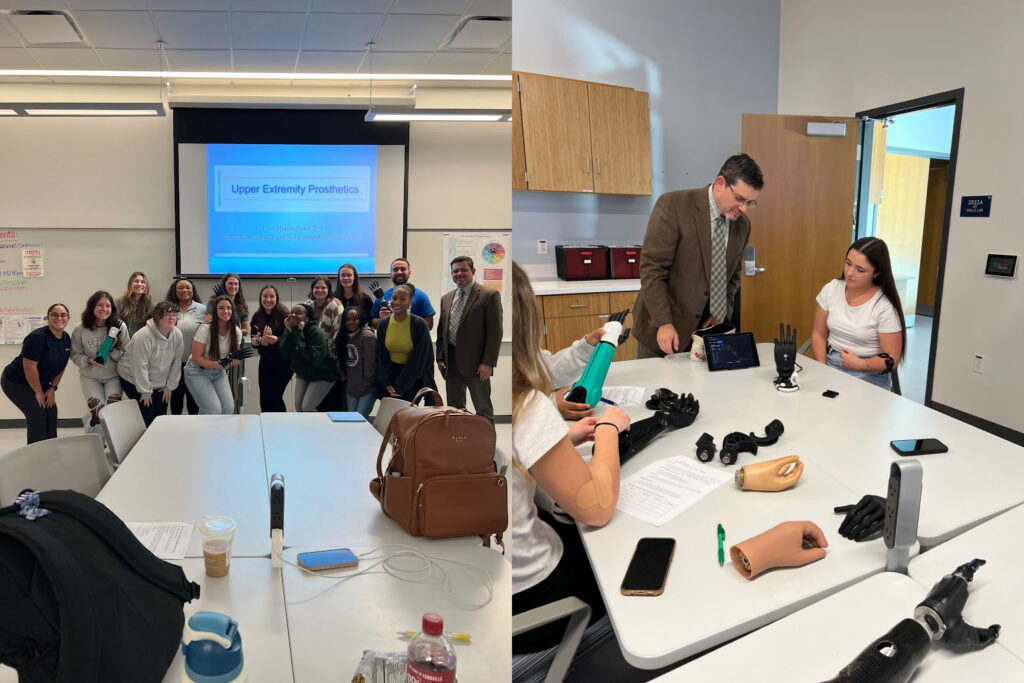
Rather than requiring every clinic to build scanning workflows, rapid test socket iteration processes and direct engineering collaboration internally, the network provides concentrated upper limb capabilities that support regional providers while allowing them to maintain focus on their broader patient population.
“When upper limb cases require advanced components or deeper iteration, our role is to provide that technical layer,” said Ian Reyes, CPO, in Atlanta. “We stay aligned with the clinic so the process remains coordinated.”
Support extends beyond fabrication and fitting. Insurance documentation strategy, candidacy assessment and outcome planning are integrated into each case to reduce administrative burden and strengthen authorization pathways.
“Strong professional partnerships improve outcomes,” said Isabel Gonzalez, CPO, in Charlotte. “When we share expertise and maintain open communication, clinics feel supported and patients benefit.”
The goal is practical: make advanced upper limb care more accessible without requiring every clinic to duplicate infrastructure.
“
“Strong professional partnerships improve outcomes. When we share expertise and maintain open communication, clinics feel supported and patients benefit.”
”
In Austin, Travis Heins has built a reputation around fabrication precision, iterative fittings and structured insurance appeals for advanced upper limb prosthetics.
His evaluations move quickly from scan to fabrication, with multiple flexible TPU test sockets printed from a single model so fit strategies can be compared during the same visit. Earlier alignment on comfort, suspension and control reduces downstream adjustments and shortens time to stable delivery.
“Printing multiple test sockets from one model lets me make informed decisions early,” Heins explained. “That level of iteration used to take weeks. Now, with 3D printing, it happens in a single appointment.”
Authorization planning begins during evaluation, with documentation strategy and physician coordination aligned before submission. Medical necessity narratives are built deliberately to anticipate payer scrutiny and strengthen approval rates for complex myoelectric systems.
“Advanced upper-limb devices require structured documentation for insurance approval,” Heins said. “We treat authorization as part of the clinical plan.”
Heins shares these fabrication techniques, documentation strategies and appeal frameworks with partner clinics through case consultations, training sessions and ongoing communication. By providing insight into scan quality, model modification and authorization preparation, he helps other providers manage complex fittings without needing to build the entire infrastructure internally.

“Upper limb prosthetics requires repetition and refinement,” Heins said. “When you work in it every day, you start seeing patterns that generalist environments might miss.”
Across our network, scanning is replacing plaster casting, refinement begins earlier and engineering collaboration remains continuous. Active case feedback informs best practices for all, allowing partner clinics to access concentrated upper limb expertise while maintaining their broader patient relationships.
Each of the 12 clinics operates within shared digital workflows, documentation protocols and upper limb–specific clinical standards. This coordinated structure allows advanced arm and hand cases to move forward with consistency while preserving the broader care networks that regional providers have built over time.
The model is designed to elevate upper limb outcomes and support existing clinics through access to advanced technology, structured insurance strategy and continuing education. Concentrated expertise strengthens complex cases without shifting ownership of the overall patient relationship.
“Listening first improves long-term outcomes,” Richards said. “The first visit sets the tone for the next decade of care.”
That philosophy extends across the network. Deliberate evaluations, early-stage refinement and proactive authorization planning strengthen patient confidence while reinforcing collaboration with partner clinics.
Upper limb prosthetics is evolving through specialization. The goal is not expansion for its own sake, but shared capacity. By concentrating advanced upper limb expertise within a coordinated national framework, O&P clinics gain access to the tools, training and support needed to deliver stronger outcomes while maintaining the relationships that define their practice.
We work with partner clinics to support the best possible outcome for patients. Connect with our team for training on our advanced bionic technology to know what’s available for your patients.
Jason, a 51-year-old Florida native, lost his hand in a die press accident at work in 2018. Because the injury occurred on the job, his recovery and prosthetic care fell under workers’ compensation.
“When I start feeling like it’s holding me back, I have to refocus my mind,” he said. “My old life ended when I got my amputation, and my new life began. I could either hide in a corner or move forward. The nub is always going to be there. So my one-handed life started, and I have to make it what it is.”
He recalled swimming from the Sarasota beach into open water, kicking hard through the waves toward a pillar jutting out of the surf. Earlier that day, he had watched kids climbing and swinging from a rope and thought, “I can do that.” When he reached the base, he grabbed a bent nail rung with his left hand and wrapped the nub of his right arm around the next rung, pulling himself up until he could swing one-handed out over the water.
Afterward, he sat on the warm sand and thought, “I’m 51. I probably shouldn’t be doing childish things.” But he refuses to let the amputation of his right hand define what he can or cannot do.

For years, prosthetics were heavy, restrictive tools Jason wore only for specific jobs.
“It was like carrying around a hammer,” he said of his older prosthetics. “I’d use it for a task, then take it off.”
Daily wear felt uncomfortable. Water exposure was always off limits. Although workers’ compensation covered his prosthetic care, Jason did not initially realize that advanced myoelectric technology, including a waterproof bionic arm, could be considered when supported by medical documentation and functional need.
After researching options online, he learned about the Hero RGD and requested an evaluation.
He connected with Emily Shannon, CPO, at our Orlando, Florida clinic. Following clinical assessment under his workers’ compensation case, he was fitted with a Hero RGD, an IPX8-rated waterproof bionic arm designed for durability, speed, and all-day wear.
Right away he noticed the difference.
“
“It feels pounds lighter. We weighed it and it’s about a pound and a half lighter, but it feels like pounds. It fits like a glove, not a hammer.” – Jason
”
“It feels pounds lighter,” he said, about his previous bionic arm. “We weighed it and it’s about a pound and a half lighter, but it feels like pounds. It fits like a glove, not a hammer.”

Living in Florida, his first instinct after the fitting was simple.
“I’m going swimming,” he said. “I’ll probably do some gardening. I’ll be mowing the yard. I’ll try riding my bike. I’ll try anything for progress.”
Progress with his Hero RGD is tangible. It is using his right hand to sign his name, peel a banana, steer a lawn mower without bruising his forearm, or gripping bike handlebars on a ride with his son. Getting caught in the unpredictable Florida rain with his bionic arm is no longer a concern. He can put it on in the morning and keep it on throughout the day because of the lightweight and breathable 3D printed socket design.
“The response time and finger roll are really quick compared to what I used before,” he said. “With the old hand, it was heavy and so bulky I didn’t want to wear it. With this one, I’m looking forward to going through my day already having a hand that can do the task.”
The Hero RGD connects wirelessly to MyoPod sensors for proportional control. It closes in 0.4 seconds, can lift up to 77 pounds, and carries an IPX8 waterproof rating designed for wet environments. Fit matters as much as hardware.
Jason’s shorter, below-elbow socket allows him to manually rotate the prosthesis as he turns his forearm.

“The thing I like most is that I can use this daily and still be ready for tasks when they come up,” he said. “I’m excited.”
The socket design was developed by Emily Shannon, CPO, at the Orlando clinic.
“Jason has had several socket designs before, but has always felt restricted by sockets that extend above the elbow,” Emily explained. “Either they were uncomfortable around his bony anatomy or limited elbow motion. We wanted to retain full range of motion at the elbow and allow some forearm rotation.”
Emily created multiple 3D printed test sockets to validate her approach and fine-tuned an adjustable socket system with compressible panels positioned above the wrist for secure suspension.
“Ultimately we determined there would be a tradeoff between suspension and range of motion,” she said. “That decision had to align with his goals and priorities.”
For workers’ compensation patients, those functional goals are central to approval decisions.
“
“The thing I like most is that I can use this daily and still be ready for tasks when they come up. I’m excited!” -Jason
”
Jason’s case highlights an important point.
If limb loss occurs at work, workers’ compensation may cover advanced prosthetic technology when it is supported by clinical documentation and functional necessity. Coverage decisions vary by insurer and state, but modern waterproof bionic arms are not automatically limited to basic solutions.
A certified prosthetist can evaluate:
Jason’s experience shows that a workers’ compensation pathway can include durable, lightweight, waterproof technology that supports everyday life.
If your limb loss occurred at work and you are navigating workers’ compensation, you may have more options than you realize. Book a free consultation to explore whether a Hero RGD could be part of your recovery pathway.
We work with partner clinics to support the best possible outcome for patients. Connect with our team for training on our advanced bionic technology to know what’s available for your patients.
How breathability, durability, adjustability, and peace of mind are driving Hero Flex adoption for clinicians and their upper-limb patients
As a certified prosthetist, you’ve probably heard a story like this before. The patient had already made up his mind before he took his old socket off for the last time. It was headed for the closet.
Mike had spent years working in the Texas heat, climbing ladders, and crawling one-handed through attics with heavy tools. He had tried to make previous myoelectric prostheses work in those environments, but heat and sweat took their toll.
“You put your arm in different positions and it gets no contact with the sensors,” Mike said. “You are in a hot attic trying to wire something up, and it just stops.”
After long days on the job, his old socket would shift, his skin would get irritated, and myoelectric control could become unreliable. Over time, he stopped trusting the device at work.
When Mike visited our Open Bionics clinic, he was looking for an option that could hold up in the conditions he worked in every day.
“
“I would have sweat pouring down my arm. I needed a wireless, waterproof, and breathable socket that I could wear all day.” – Mike T.
”
Versions of this story show up often in our clinical settings. The details change, but not the intent. Patients want a socket that stays comfortable, works reliably, and holds up in the environments they actually live and work in.
Hero Flex was developed over four years directly from that feedback. Patient experiences with heat buildup, sweat retention, inconsistent suspension, and skin irritation shaped the design priorities long before the socket reached production.
Sweat, Breathability, and Skin Health
For many patients, heat and moisture are the first failure point.
“The most common problems that the Hero Flex was designed to solve are the lack of breathability,” said Travis Heins, a certified prosthetist in our Austin, Texas clinic with a fabrication background. “Traditional sockets create a microclimate with much higher humidity and moisture than is comfortable, and that can cause skin breakdown. Because of that, wired electrodes tend not to work as well.”
He has recently seen several patients who switched to 3D-printed sockets after years in laminated, non-ventilated designs. Many had dealt with chronic rashes, recurrent skin irritation, or bacterial infections that forced time out of their prosthesis.

Another one of Travis’ patients, who works in the Texas heat as a professional Santa, described long days in a heavy coat.
“I would have sweat pouring down my arm,” he said. “I needed a wireless, waterproof, and breathable socket that I could wear all day.”
Hero Flex addresses this structurally with a removable flexible liner designed with vented flutes that channel heat and moisture away from the skin instead of trapping it. That airflow geometry is only possible through modern 3D printing, which allows consistent channel depth and spacing throughout the socket. The result is drier skin, more stable EMG contact, and longer, more comfortable wear time.
That comfort advantage is reflected in user feedback. In a year-long average of patient-reported outcomes, the 3D-printed flexible liner scored 9.2 out of 10 for comfort, reinforcing the clinical observation that breathable, flexible liners are more likely to be worn consistently throughout the day.
Lightweight Without Sacrificing Durability

For Mike, the durable and waterproof design changed how cautious he needed to be.
“This thing is great,” he said. “I can wash dishes with it or whatever. If I am out and about and it starts raining, I can keep it on. Before, I had to grab a plastic bag and cover up the arm because if it got wet, it was done.”
Traditional laminated sockets often increase in weight during fabrication as resin is added to strengthen the build and smooth the fit. That added weight can compound fatigue, especially for myoelectric hand users.
Hero Flex takes a different approach. The socket frame is printed using PA12 (Nylon 12), delivering structural strength without the weight, bulk, or variability of traditional laminated builds. PA12 offers a high strength-to-weight ratio, strong fatigue resistance, and excellent dimensional stability, allowing the socket to remain rigid where support is needed while still accommodating cutouts, venting, and modular features without compromising durability.
Unlike laminated composites, PA12 does not delaminate over time and is largely unaffected by moisture, sweat, or temperature changes. For clinicians, this means a socket that behaves predictably, can be digitally reproduced if needed, and supports precise, repeatable fits without relying on excess material to achieve strength.

Two years after losing his arm below the elbow, former blacksmith John Whitman was back in the gym with a different goal entirely. Fitted with a Hero Flex activity arm earlier this year, John began training three to four days a week toward a Guinness World Records attempt for the most weight lifted by bench press in one hour.
What made the difference was consistency. The lightweight, breathable socket allowed him to train for long sessions without heat buildup or suspension issues, while its stability under load meant he could focus on repetition rather than readjustment.
“It was a game changer,” John said. “Getting outdoors and the gym really felt like gaining a bit of old me back.”
For Ricky, a Louisiana farmer and construction worker, durability translated into confidence with heavier tools.
“From the other prosthetics we looked at, this one can pick up more weight,” Ricky said. “I got a chainsaw, and I have trees and fence lines I need to clear.”
Adjustability, Flexibility, and Day-to-Day Fit

Residual limbs change. Volume fluctuates. Traditional rigid sockets leave little margin for those realities.
“Lack of volume fluctuation accommodation is a big issue,” Travis said. “Traditional sockets are rigid. If you’re trying to grab up and above someone’s elbow with something fixed or minimally flexible, it becomes extremely difficult to put on if it’s tight enough to hold body weight.”
Hero Flex combines a flexible inner liner, an open-frame design, and a BOA tightening system that allows users to fine-tune suspension throughout the day. The system also accommodates MyoPod cutouts, giving clinicians flexibility in sensor placement and allowing users to self-select EMG depth as their limb changes.
“
“It was a game changer. Getting outdoors and the gym really felt like gaining a bit of old me back.” -John
”
If the fit ever needs adjustment due to significant volume change, the flexible inner liner can be reprinted from the original digital file without restarting the entire socket process. Clinicians can preserve suspension and alignment while making targeted adjustments, reducing remake risk, chair time, and patient downtime.
Adjustability mattered immediately to Mike.
“This one is adjustable. I really like that feature,” he said. “The other one made my arm swell up because it could not breathe, then I’d have to take it off.”
Emily Shannon, a certified prosthetist in the Orlando, Florida clinic, frames fit priorities simply.
“Comfort and suspension,” Emily said. “If it’s not comfortable, they’re not going to use it. If it doesn’t stay on, it’s not practical.”
She also highlights an often overlooked factor.
“Ease of donning and doffing,” she said. “Just because it looks and fits well once it’s in there, considering how someone can put it on independently could make or break whether it’s a successful outcome.”
For patients with more complex donning mechanics, Hero Flex can be fabricated with features like a pull-through hole to support independent use with donning sheaths.
Peace of Mind for Clinicians, Especially Without Central Fabrication

For CPOs, particularly those without central fabrication, upper-limb sockets can feel high-risk.
Hero Flex reduces that risk through reproducibility and post-delivery adjustability. Flexible inner liners can be modified or remade digitally. Global size changes can be requested without rebuilding the entire socket. Inner pads can be added to increase medial-lateral compression by about a quarter inch when needed.
“Striking the balance of the correct amount of tension proximal to the epicondyles is much more forgiving with our system because adjustability is built in,” Travis said.
For patients traveling long distances, that flexibility matters.
“For a fitting, I’ll preemptively print two or three or four test sockets knowing they traveled a long way,” Travis said. “I want to make sure we have something that works and don’t have to reschedule or ask them to take more time off and book another hotel.”
What ultimately separates Hero Flex from traditional sockets is not a single feature, but how the system behaves over time. Breathability protects skin health. Lightweight construction reduces fatigue. Adjustability absorbs daily and seasonal limb changes. Digital fabrication makes refinements predictable instead of disruptive.
As Travis puts it, the goal is not perfection on day one, but confidence that the socket will keep working as real life intervenes.

“You want it tight enough to suspend, but still comfortable,” he said. “The difference with Hero Flex is that you don’t have to get everything exactly right in one moment. You have room to adjust, to respond, and to keep refining over time without starting over. That takes a lot of pressure off the clinician, and it keeps patients wearing the socket instead of putting it in the closet.”
That combination of patient comfort and clinician confidence is why Hero Flex gets worn.
If your socket no longer fits the way it should, book a free consultation with an upper-limb specialist to try a Hero Flex.
We work with clinicians to support the best possible outcome. Connect with our team for training on our advanced bionic technology to know what’s available for your patients.


