Athletes in the Open Bionics community train for the Paralympics, compete in karate, attempt Guinness World Records, and ride BMX. What connects them is the Hero Arm Ecosystem, built around the Hero Flex socket, which connects directly with both the Hero PRO and Hero RGD bionic hands and a range of sport-specific activity attachments.
That combination of socket, hand, and interchangeable attachments means one arm can serve a triathlete’s training week, a teenager’s karate practice, and a farmer’s full working day. For athletes with upper limb differences, it removes one of the most persistent friction points in adaptive sport: needing to carry multiple prostheses to stay active across different disciplines.
Modern prosthetics for athletes are designed to support:
Torie Mugo was a marathon runner before contracting the flu, which progressed into severe septic shock and multiple organ failure. Life support saved her life but resulted in quadruple limb loss — both hands amputated at the wrist and both feet below the knee. She trained herself to walk with her first leg sockets before her physical therapy had even begun.
Today, Torie is training toward the LA 2028 Paralympic Games. She received funding for two Hero Flex activity arms through a CAF Adaptive Sports Equipment Grant and uses them across her full triathlon training load — alternating between running, biking, and swimming throughout the week. She has already completed 47 miles in a single week on the bike alone.
Torie’s story reflects what the Hero Flex system was built for: a socket and attachment platform that can move between disciplines without requiring the athlete to stop, change devices, or compromise on performance in any of them.
John Francis was born without part of his right arm and hand in Baton Rouge, Louisiana. As he grew older, everyday tasks including dressing, going to school, and participating in karate became more difficult. He researched prosthetic options independently and identified the Hero PRO as the device he wanted.
Insurance would not cover the cost. His family launched a GoFundMe campaign and their community raised nearly $30,000 in four and a half days. John now uses his Hero PRO to accomplish more on the karate mat, ride a bike around his neighborhood, and make meals independently.
“This has been a complete game changer and I’m not sure what my life would be like if I hadn’t gotten it,” John said. His mother Monica noted the change in how he carries himself. “He used to stand always holding his nub and his head kind of down and now you never see him like that anymore,” she said.
John has plans to study medical engineering and work on prosthetic technology. His story is also covered in the blog on prosthetic insurance coverage, where his case illustrates the gap between clinical need and insurer classification.
John Whitman, a former blacksmith who lost his arm below the elbow after a workplace accident, bench-pressed 6,000kg in one hour wearing a Hero Flex activity arm, nearly tripling the previous record of 2,100kg. The result has been submitted for official Guinness World Records verification.
“It was a game changer,” John said. “Getting outdoors and the gym really felt like gaining a bit of old me back.”
Jason uses the Hero RGD for a working life that moves between a farm, a construction site, and the trails where he rides BMX. He compared it directly to the prosthetics he had used previously, describing it as lighter, more durable, and waterproof in a way that changed how freely he could move between activities.
The Hero RGD’s fully waterproof enclosure and titanium reinforcement make it the device of choice for users whose sport and work lives involve physical stress, weather exposure, and sustained load. With a carrying capacity of up to 77 pounds, it is built for the environments where other devices require caution or removal.
What makes the athletic use cases above possible is the Hero Flex socket. Rather than a fixed device for a single purpose, Hero Flex is a 3D-printed breathable socket platform that connects to both the Hero PRO and Hero RGD bionic hands, as well as a range of activity attachments designed for specific sports and tasks.
The USMC-standard wrist connector allows users to switch between a bionic hand and a sport attachment in seconds. A triathlete can move from cycling to running to daily use without changing arms. A martial artist can switch from training to the kitchen without adjusting their setup. The system is designed around the reality that athletes do not live in a single discipline.
Athletic performance depends on fast, precise reactions. The Hero PRO and Hero RGD are two times faster than leading bionic hands on the market. The wireless MyoPod electrode system detects muscle signals with low latency and translates them into grip patterns without the disruption associated with wired electrode systems. For athletes, that responsiveness means less hesitation between intention and action across every discipline.
Both devices are fully wireless and waterproof — the only bionic arms in the world with that combination — allowing athletes to train in rain, sweat-intensive environments, and water sports without removing or protecting the device.
Open Bionics has fitted more than 1,000 users with bionic arms and operates specialist upper limb clinics across the United States. Every device is custom-fabricated to the individual’s residual limb, and the fitting process incorporates activity and sport goals from the first consultation. Where sport is a priority, clinicians help configure the Hero Flex socket, select the right terminal device, and advise on activity attachments suited to the user’s specific disciplines.
Can athletes compete with prosthetic arms?
Yes. Open Bionics users compete in adaptive sports ranging from triathlon and karate to BMX and strength events. The Hero Flex socket combined with the Hero PRO or Hero RGD and sport-specific activity attachments supports performance at recreational, national, and international levels, including Paralympic-level competition.
What prosthetic arm is best for sports?
The Hero Flex socket is the foundation of athletic use at Open Bionics. It connects to both the Hero PRO and Hero RGD bionic hands, as well as a range of activity attachments. The right configuration depends on the athlete’s sport, residual limb, and activity goals. A certified prosthetist can advise on the best setup for your specific disciplines.
Can you lift weights with a prosthetic arm?
Yes. The Hero RGD is designed to carry up to 77 pounds and features impact-resistant components built for repetitive loading. John Whitman bench-pressed 6,000kg in one hour using a Hero Flex activity arm, with the result submitted for Guinness World Records verification. Activity attachments can be configured for specific gym exercises.
Are bionic prosthetic arms waterproof?
The Hero PRO and Hero RGD are fully waterproof, allowing athletes to train in rain, high-sweat environments, and water-based sports. They are the only fully wireless and waterproof bionic arms currently available anywhere in the world.
Can prosthetic arms be used for multiple sports?
Yes. The Hero Flex socket uses a USMC-standard wrist connector that allows users to switch between a bionic hand and sport-specific attachments in seconds. Torie Mugo uses her Hero Flex arms across running, cycling, and swimming as part of her Paralympic triathlon training, moving between disciplines without changing devices.
Can I use a prosthetic arm for rock climbing?
Rock climbing places specific grip and load demands on a prosthetic device. Luke, known as Bionic Luke, is an Open Bionics user who took up rock climbing as part of his goal to match able-bodied performance in physically demanding sports. An Open Bionics clinician can advise on socket configuration and activity attachment options suited to climbing based on your residual limb and climbing goals.
Can I swim with a bionic arm?
Hero RGD is fully waterproof and can be worn in water. For competitive or training swimming, activity attachments are available to support specific stroke mechanics. An Open Bionics clinician can advise on the right configuration for your discipline.
How fast does a bionic prosthetic hand open and close?
The Hero PRO and Hero RGD open and close twice as fast as leading bionic hands on the market. That speed is driven by the wireless MyoPod electrode system, which detects muscle signals with low latency and translates them into grip patterns with minimal hesitation between intention and action.
Can children use prosthetic arms for sport?
Yes. The Hero Arm is available for children as young as five. Open Bionics users including Kiowa, an 11-year-old who wears the Hero Flex with activity attachments, uses his devices for biking, taekwondo, archery, and other physical activities. The fitting process for pediatric users considers sport and activity goals from the first consultation.
You do not have to navigate the insurance process alone. To find out whether a Hero Arm, Hero PRO, or Hero RGD may be covered under your plan, book a free consultation with your nearest Open Bionics clinic. The team will walk you through eligibility, documentation, and next steps.
A significant policy change took effect in September 2025 that directly affects access to 3D printed bionic arm insurance coverage. The organizations overseeing Medicare billing and device classification announced that 3D printing is now an approved fabrication method for custom prosthetic sockets and limbs. For people with upper limb differences exploring advanced bionic technology, that shift has real practical consequences.
A 3D printed bionic arm can now qualify for Medicare coverage if it meets the same medical standards and documentation requirements as any other prosthesis. Because Medicare policy typically sets the benchmark that private insurers follow, this update marks a meaningful step forward for accessibility across the board.
Before September 2025, the absence of explicit coding recognition for 3D printed prosthetics created ambiguity in insurance submissions. Clinicians could submit claims, but without a clear billing pathway, approvals were inconsistent and often dependent on the individual insurer’s interpretation of existing codes.
The updated national coding framework removes that ambiguity. A 3D printed prosthetic socket fabricated to clinical standards now has a defined place within the billing system. For devices like the Hero PRO and Hero RGD, which use 3D printed flexible inners and rigid frames, this creates a more direct route to coverage authorization.
The first step toward bionic arm insurance coverage is a free consultation at an Open Bionics clinic. Before that appointment, it helps to gather any existing prosthetic records or physician notes, and to think through the specific activities and goals you want a bionic hand to support.
Elise Dreiling, certified prosthetist and director of clinical operations at the Open Bionics clinic in Denver, Colorado, said the initial consultation is designed to be unhurried and personal. “I talk to patients the way I talk to friends and family,” she said. “I don’t use clinical jargon or medical acronyms. Our initial appointments are long by design so people feel heard, valued, and confident about the next steps.”
Users come to Open Bionics clinics with goals that range across every area of daily life. Some of the tasks people most commonly want to reclaim include:
During the consultation, the clinician explains the available device options and helps determine which configuration best fits the patient’s needs. The Hero Arm is suited to children and teens building independence in everyday tasks. The Hero PRO offers speed, precision, and water resistance for cooking, cleaning, and typing. The Hero RGD is built for demanding physical environments including construction, landscaping, farming, and outdoor work where grip security and durability are essential.
Emily Shannon, certified prosthetist at the Open Bionics clinic in Orlando, Florida, said the most common barrier to coverage is not the policy itself but the submission process. “A lot of people assume insurance won’t pay,” she said. “When we map the request to the plan’s criteria and push through the right channels, coverage becomes possible.”
“
“A lot of people assume insurance won’t pay. When we map the request to the plan’s criteria and push through the right channels, coverage becomes possible.”
”
After the initial consultation, the next appointment is an in-person evaluation. The clinician takes detailed measurements and creates a digital model of the residual limb. Small sensors placed on the skin locate the strongest muscle signals, and the patient can observe the bionic hand respond to their own signals in real time.
Emily said the administrative work that follows the evaluation is handled entirely by the clinic team. “After the evaluation, we handle the benefits check, the clinical notes, document the desired outcomes, take photos, and draft the letter to insurance outlining medical necessity,” she said. “Patients don’t have to navigate that alone.”
Insurance denials are a regular part of advanced prosthetics, and they are not the end of the process. Both Elise and Emily described appeals as a core part of their clinical work, and both said outcomes frequently improve on appeal.
“Appeals are part of advanced prosthetics,” Emily said. “With an appeal, we have the chance to reference the plan’s criteria, add data, and advocate. People are often surprised by what an appeal can unlock.”
Elise said her approach to a denial letter is methodical. “When we get a denial letter, I start by going line by line through the policy to show how the patient meets each criterion,” she said. She added that many insurer policies cite research that predates current bionic technology. “Most cite research that’s 10 or 15 years old,” she said. “This technology didn’t exist back then. With the appeal, I include current, peer-reviewed studies so reviewers can see the difference.”
“
“When we get a denial letter, I start by going line by line through the policy to show how the patient meets each criterion.”
”
Her persistence reflects a pattern she has observed across many cases. “Appeals take work, but they matter,” Elise said. “In my experience, roughly half of appealed denials overturn. Policy updates in healthcare move slowly, but the more we can bring these gaps to light, the more we can shift expectations for coverage.”
Both clinicians said their role extends well beyond fitting. Navigating 3D printed bionic arm insurance coverage requires clinical documentation, knowledge of insurer criteria, and a willingness to challenge denials with current evidence. That combination is part of what Open Bionics clinicians bring to every case.
“We’re playing the long game, building trust and finding the right solution for each person,” Emily said. “That starts with listening.”
“
“We’re playing the long game, building trust and finding the right solution for each person. That starts with listening.”
”
You do not have to navigate the insurance process alone. To find out whether a Hero Arm, Hero PRO, or Hero RGD may be covered under your plan, book a free consultation with your nearest Open Bionics clinic. The team will walk you through eligibility, documentation, and next steps.
Elise Dreiling is a certified prosthetist and director of clinical operations at the Open Bionics clinic in Denver, Colorado. Emily Shannon is a certified prosthetist at the Open Bionics clinic in Orlando, Florida. Both specialize in upper limb prosthetics and insurance advocacy for patients pursuing advanced bionic devices.
For many people with upper limb differences, the question of where to buy prosthetics is one of the first and most disorienting they face. The path from limb difference to a well-fitted, functional device is rarely straightforward. It involves navigating insurance, understanding funding options, finding a clinic with genuine upper limb expertise, and working out which technology actually suits the life you want to live.
Lucas Slusher, a Hero PRO user who was born with a congenital upper limb difference, spent years working through that process before finding Open Bionics. He remembers the early confusion clearly. “I kept asking myself, where do I even go to buy these arms?” he said. “That mix of hope and feeling overwhelmed is something anyone starting out can relate to.”
The first step for most people searching where to buy prosthetics is an online search that returns more questions than answers. Slusher said his experience with Open Bionics felt different from the start. “It’s not like shopping online,” he said. “You click ‘Book Demo‘ and start with a free, no-pressure call.”

That initial conversation is handled by clinicians who work with people across the full spectrum of upper limb differences, including congenital limb differences and acquired limb loss, more than most providers. They walk prospective patients through whether a Hero Arm, Hero RGD, or Hero PRO is the right fit, based on their daily demands, activity level, and goals. No commitment is required to have that conversation.
Slusher said the first call was a turning point. “For the first time, someone really understood that every limb difference, every story, is unique and personal,” he said.
After the initial consultation, Open Bionics takes a 3D scan or cast of the residual limb and creates a custom-fit device. All Open Bionics devices are designed for below-elbow differences, whether congenital or acquired.
“
“For the first time, someone really understood that every limb difference, every story, is unique and personal.”
”
The Hero Arm is lightweight and intuitive, available for adults and children as young as five. The Hero PRO and Hero RGD add increased grip strength, speed, and adaptability, and both are completely wireless, water resistant, and touchscreen compatible. The flexible socket design and 3D-printed construction produce a fit that is typically more comfortable than older fabrication methods.
Slusher said comfort is not incidental to consistent prosthetic use. “Comfort isn’t a luxury,” he said. “It’s essential if you want to wear your prosthesis every day, all day.”

For people considering where to buy prosthetics, the question of durability is often as important as the question of fit. The Hero line is built from Nylon PA12, the same material used in ski boots, making it well suited to the physical demands of daily life including wet, messy, and high-contact tasks.
Slusher said the transition to the Hero PRO changed what he expected from a prosthetic device. “I wondered if it would really hold up in everyday life,” he said. “It isn’t just about looking cool. It’s about doing laundry, dishes, typing on your phone, or lifting heavier items without worry. That kind of freedom changed everything for me.”
“
“It isn’t just about looking cool. It’s about doing laundry, dishes, typing on your phone, or lifting heavier items without worry. That kind of freedom changed everything for me.”
”
Open Bionics operates a growing network of clinics across the United States. For patients who do not have a clinic nearby, the team helps connect them with partner locations and coordinates care remotely where possible. The company is expanding its clinic network, and additional locations continue to come online.
Every Hero PRO and Hero RGD delivered directly through an Open Bionics clinic is backed by the Perfect Fit Promise, a 60-day fit guarantee, and three years of HeroCare coverage. That includes training, customer support, and coverage for manufacturing faults, with no hidden costs.
Slusher said the support structure was as important to him as the technology itself. “What I loved about Open Bionics wasn’t just the technology,” he said. “It was the people. The clinicians who understood limb difference, the community of users, and a company committed to making bionics accessible. I never felt like just a customer.”
“
“What I loved about Open Bionics wasn’t just the technology. It was the people. The clinicians who understood limb difference, the community of users, and a company committed to making bionics accessible. I never felt like just a customer.”
”
If you are considering Hero PRO or Hero RGD, visit book a free consultation to learn how a bionic arm could help you reach your goals.
Access to specialized upper limb prosthetic care has long been shaped by geography. For individuals with limb differences in the Northeast, the distance to a dedicated bionic arm clinic can make consultations, fittings, and follow-up appointments difficult to sustain. Open Bionics is addressing that directly with monthly prosthetic arm clinic appointments in Philadelphia, led by Daniel Green, CPO, clinical lead of the Open Bionics New York clinic.
The Philadelphia pop-up clinics are designed for individuals who want access to advanced upper limb prosthetic technology without the cost and time burden of repeated long-distance travel. They are open to children, teens, and adults with below-elbow, wrist, and partial hand amputations or congenital limb differences.
Daniel said the decision to expand into Philadelphia is a fairly straightforward clinical principle. “Specialized upper limb care should not depend on your zip code,” he said. “By bringing our team to Philadelphia each month, we are making it easier for people to explore advanced bionic technology without the burden of frequent long-distance travel.”
“
“Specialized upper limb care should not depend on your zip code. By bringing our team to Philadelphia each month, we are making it easier for people to explore advanced bionic technology without the burden of frequent long-distance travel.”
”

Each appointment at the Philadelphia clinic offers a zero-commitment introduction to Open Bionics’ devices and clinical process. Patients can receive a device demonstration, observe how our modern wireless and waterproof EMG systems respond to muscle signals in real time, and discuss goals with a certified prosthetist.
The Hero PRO and Hero RGD are available for demonstration at these sessions. Patients can explore features including multi-grip functionality, waterproof components, and lightweight 3D-printed sockets during their visit.
Daniel, a Certified Prosthetist with extensive experience in upper limb prosthetics, said the first appointment is primarily about listening. “Upper limb prosthetics require a different level of precision and personalization,” he said. “When someone is considering a bionic arm, they deserve time, attention, and a plan that reflects their goals at work, at home, and in their community.”
“
“Upper limb prosthetics require a different level of precision and personalization. When someone is considering a bionic arm, they deserve time, attention, and a plan that reflects their goals at work, at home, and in their community.”
”
For many patients, the Philadelphia clinic is their first direct experience with current bionic arm technology. Daniel said the moment when a patient first feels the device respond to their muscle signals is often a turning point. “The moment they realize the hand responds naturally to their muscle signals, you can see the shift,” he said. “It becomes less about a device and more about what is possible again.”
Patients who begin their journey at a Philadelphia pop-up clinic continue through the full Open Bionics clinical process. Digital scanning, socket design, and Sidekick App training are all coordinated through the same network. Where more advanced fittings or follow-up care are required, the New York clinic provides that support.
Daniel said that continuity is central to how the pop-up model is designed. “The pop-up clinic is the starting point,” he said. “From there, we guide each person step by step, whether that means additional visits in Philadelphia or coordination with our New York clinic for advanced fittings and follow-up care.”
Clinicians at Open Bionics handle significantly more upper limb cases than the industry average. That volume translates into focused expertise in fitting and adjusting the Hero PRO and Hero RGD, and it is the clinical foundation that makes a monthly satellite clinic viable.

The Philadelphia pop-up clinic is part of a broader effort to expand access to specialized bionic arm care across the Northeast. Daniel leads both the New York clinic and the monthly Philadelphia sessions, providing patients in both locations with consistent clinical leadership and direct access to a prosthetist with deep, device-specific experience.
“Every person who walks through our doors has a different story,” Daniel said. “Our job is to listen first, then build a solution that fits their life. Bringing that opportunity to Philadelphia is something we are incredibly proud of.”
If you are in the Philadelphia area and considering a Hero Arm, Hero PRO, or Hero RGD, visit our Open Bionics popup clinic learn more about how our devices are designed, fitted, and supported by the team that knows them best. To find out what your first weeks with a new bionic arm would look like, book a free consultation with Daniel Green to find out when and where then next clinical popup will be held.
A prosthetic arm warranty typically covers repairs. What it rarely covers is the clinical relationship, the fit process, or the day-to-day support that determines whether a device gets used consistently. HeroCare, Open Bionics’ three-year support program, was built around a different assumption: that long-term adoption depends on more than hardware, and that users deserve reliable access to the people and systems that keep their device working.
HeroCare applies to every Hero Arm, Hero PRO, and Hero RGD delivered directly through an Open Bionics clinic. It covers manufacturing faults across the full device, including myoelectric components and the flexible inner socket. It also includes the 60-day fit guarantee that forms the foundation of the Perfect Fit Promise, along with prosthetic training, customer support, and optional annual servicing. For users who come directly to an Open Bionics clinic, coverage is integrated with a fitting process and a clinical relationship that carries through the full three years.

The practical value of HeroCare begins with how support is accessed. Emily Shannon, a clinical prosthetist at the Open Bionics clinic in Orlando, Florida, said direct clinician access is one of the program’s most significant advantages.
“My patients can call me and say something is loose or not working, and I can address it immediately,” she said. “If I need to escalate something, I have a direct line to the engineering or maintenance team. There is no middleman slowing things down.”
“
“My patients can call me and say something is loose or not working, and I can address it immediately. If I need to escalate something, I have a direct line to the engineering or maintenance team. There is no middleman slowing things down.”
”
That directness has practical consequences. When a user contacts their Open Bionics clinician, the person on the other end of the call already knows the patient’s residual limb, their electrode sensitivity settings, and their daily use patterns. The diagnostic process starts from an informed position rather than from scratch.
Advanced prosthetic devices require maintenance over time. HeroCare is designed to minimize the disruption when that happens. If a repair is needed, Open Bionics provides a loaner hand that reaches most users within three days. That turnaround is significantly faster than the timelines common with traditional prosthetic manufacturers, where devices are routed through third-party distributors or shipped overseas before they are assessed.
“
“Patients at other clinics could end up waiting without any device because the clinic has to ship the hand off to the manufacturer, sometimes overseas. It can lengthen the whole process.”
”
Jonah Rhymer, a certified prosthetist at the Open Bionics clinic in Chicago, Illinois, said the contrast with other brands is most visible when something goes wrong. “Patients at other clinics could end up waiting without any device because the clinic has to ship the hand off to the manufacturer, sometimes overseas,” he said. “It can lengthen the whole process.”
With HeroCare, the repair process stays within the same organization that built the device. Open Bionics is a US-based company, and the team handling a repair request is the same team that designed and manufactured the hardware.
Each Hero Arm, Hero PRO, and Hero RGD is built from more than 100 individual components. That modularity is a deliberate engineering choice that directly supports the repair model within HeroCare. When a specific part wears or fails, the clinical team can replace that component without disturbing the fit, alignment, or aesthetics of the rest of the device.
Jonah said this approach matters for users who depend on their arm for work or daily routine. “If something breaks, we do not have to take apart the whole prosthesis,” he said. “We can replace the exact part that needs attention. It keeps downtime short and reduces the frustration users feel when they have to send away something they depend on.”
“
“If something breaks, we do not have to take apart the whole prosthesis. We can replace the exact part that needs attention. It keeps downtime short and reduces the frustration users feel when they have to send away something they depend on.”
”
The modular approach also supports longer-term device management. Components can be upgraded independently as new versions become available, and users maintain continuity with the cosmetic finish they chose at delivery.
Emily said one of the less visible aspects of HeroCare is how user feedback is handled at the engineering level. She described a recent case involving a Hero Gauntlet user whose experience with a specific component prompted a direct conversation with the product team.
“I had the engineering team video call in with the patient and we problem-solved together,” she said. “I told the patient, you are literally informing future developments of this product by having this conversation. That is something you do not get in another clinic.”
That feedback loop is a structural feature of working with a manufacturer that also operates clinics. Clinical observations reach the engineering team through a short internal path, and product changes can be informed by real-world use data rather than formal complaint processes alone.
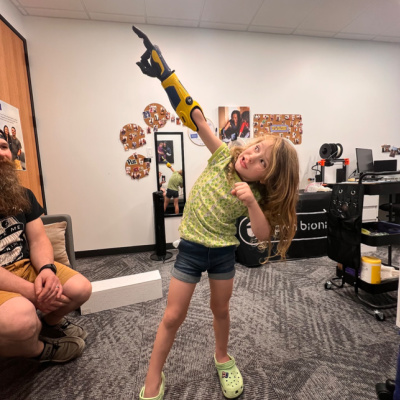
Most prosthetic arm warranties are transactional. They define what is covered, what is excluded, and how to submit a claim. The user’s experience of the warranty depends largely on the responsiveness of whoever handles that claim, which often involves multiple parties.
HeroCare differs in three ways. First, the manufacturer and the clinician are the same organization. When a user contacts Open Bionics about a problem, there is no handoff between a clinic and a manufacturer because those functions sit within the same team. Second, coverage is built around real-world use rather than ideal conditions. Volume fluctuations, component wear, and the demands of daily activity are expected and accounted for. Third, the technology in the Hero PRO and Hero RGD requires support from people who understand it at an engineering level. HeroCare ensures that repairs are handled by clinicians and technicians with specific training in these devices, not by general prosthetic labs working from a generic service manual.
Emily said the program’s underlying purpose is reliability. “We never promise that things do not break,” she said. “But we have a system in place to address them quickly. That makes all the difference for users who want reliability.”
Jonah framed it in terms of long-term adoption, which he described as his primary clinical goal. “If it does not fit or does not work, it ends up in a closet,” he said. “HeroCare and the Perfect Fit Promise are how we prevent that. We make sure the device works for them, not the other way around.”
“
“If it does not fit or does not work, it ends up in a closet. HeroCare and the Perfect Fit Promise are how we prevent that. We make sure the device works for them, not the other way around.”
”
A prosthetic arm warranty that covers repairs is a starting point. HeroCare is built on the premise that what users actually need is a support structure that keeps the device functional, the fit accurate, and the clinical relationship intact for the full duration of their coverage.nd providing access to annual servicing and ongoing clinical guidance.
If you are considering a Hero Arm, Hero PRO, or Hero RGD, coming directly to an Open Bionics clinic means your device is designed, fitted, and supported by the team that knows it best. To find out what your first weeks with a new bionic arm would look like, book a free consultation with your nearest Open Bionics clinic.
Getting a bionic arm is a significant milestone. Prosthetic arm fitting shapes everything that follows: how confidently a user wears the device, how accurately the electrodes detect muscle signals, and whether the arm becomes a natural part of daily life or sits in a drawer. At Open Bionics, the Perfect Fit Promise exists to protect that process. Every Hero Arm, Hero PRO, and Hero RGD user receives dedicated fitting time, clinical support, and adjustment windows so the device feels secure and comfortable from day one.
The prosthetic socket is the point of contact between a user and their device. Clinical research consistently identifies socket fit as the primary factor in whether a prosthesis gets used at all. A device that is uncomfortable, poorly suspended, or unreliable in its signal detection will be abandoned regardless of its technical specification.
Emily Shannon, a clinical prosthetist at the Open Bionics clinic in Orlando, Florida, said the two non-negotiables at every fitting are comfort and suspension. “If it is not comfortable, they are not going to use it,” she said. “If it does not stay on, it is not practical.”
“
“If it is not comfortable, they are not going to use it. If it does not stay on, it is not practical.”
”
Jonah Rhymer, a certified prosthetist at the Open Bionics clinic in Chicago, Illinois, works from the same principle. “Ultimately that is my objective with everything I do,” he said. “If the fit is not accurate, the prosthesis is not going to work at all.”
Every Hero PRO or Hero RGD delivered directly through an Open Bionics clinic includes a socket fitting service with a 60-day fit guarantee. That guarantee sits within a three-year HeroCare coverage program that also covers manufacturing faults, optional annual servicing, customer support, and prosthetic training with an Open Bionics clinician. There are no hidden costs.

The 60-day window is intentional. Residual limbs change in the weeks following a new fitting, particularly for users who are building up wear time or returning to higher activity levels. Volume fluctuations are common, and a socket that fits well on delivery day may need adjustment as the limb settles. The Perfect Fit Promise gives users the clinical access to address that without hesitation.
Jonah said a successful fit at delivery meets three specific criteria. “Is the prosthesis suspending, is it not causing any irritations, and if we remove it, is there going to be redness or discomfort that does not go away while they are in the office,” he said. “To me that hits it.”
“
“Is the prosthesis suspending, is it not causing any irritations, and if we remove it, is there going to be redness or discomfort that does not go away while they are in the office. To me that hits it.”
”
Emily said her evaluation at fittings extends well beyond socket geometry. She considers the practical realities of long-term use, including how easily a user will be able to put the arm on and take it off independently. “Fit is one thing, but there are a lot of other elements,” she said. “For some people, ease of donning and doffing can make or break whether the outcome is successful.”
That level of evaluation is only possible when the clinician has deep familiarity with the specific device being fitted. Emily said that familiarity is one of the structural advantages of coming directly to an Open Bionics clinic. “We are very familiar with the material properties of the end product,” she said. “At the test socket fitting, I explain what you are trying on today and how the real one will behave. We know how the choices we make in the fitting translate into the final socket.”
Open Bionics designs and manufactures the Hero PRO. That distinction matters in a clinical context. Prosthetists at Open Bionics clinics fit these specific devices every day. They understand the socket materials, the electrode placement requirements, the way the flexible inner behaves over time, and the relationship between test socket decisions and the finished build. That knowledge is not transferable to a general prosthetics clinic in the same way.
“
“At the test socket fitting I explain what you are trying on today and how the real one will behave. We know how the choices we make in the fitting translate into the final socket.”
”
The manufacturing process also gives Open Bionics clinicians more flexibility when adjustments are needed. Traditional prosthetic sockets are fabricated using methods that often require a full remake when the fit needs significant changes. Open Bionics uses 3D-printed flexible inners and digital designs that allow for more targeted modifications. Jonah said this is a meaningful clinical advantage.
With a 3D-printed system, he explained, it is possible to adjust the flexible inner in a controlled, global way rather than starting from scratch. For a user whose limb volume changes during the first months of wear, that flexibility translates directly into faster, more precise resolution when something needs to change.
The Perfect Fit Promise is the front end of the wider HeroCare support program. When a patient receives a Hero PRO directly from Open Bionics, the same integrated team that designed and built the device is responsible for fitting it, training the user, and supporting them through any issues that arise over three years of coverage.
That continuity is clinically significant. The first few weeks of prosthetic arm fitting shape long-term adoption. A comfortable socket encourages consistent wear, faster myoelectric learning, and better functional outcomes. A poorly fitting socket slows that progress and can create frustration that is difficult to reverse. The Perfect Fit Promise protects the time and clinical attention needed to get the foundational fit right.

It also removes a common barrier. Many users hesitate to return for adjustments because they are unsure whether their concerns are significant enough to warrant an appointment, or because they worry about cost. The guarantee removes both of those hesitations during the most important phase of the journey.
The fitting process at an Open Bionics clinic follows three appointments: an initial evaluation, a test socket fitting, and a delivery appointment. Each stage builds on the last. By the time the finished device is delivered, the clinician has a detailed picture of how the residual limb behaves, where the electrode sites sit most reliably, and what adjustments the socket may need over time.
After delivery, the 60-day fit guarantee means users can return for adjustments without hesitation. The HeroCare program then continues that support for three years, covering the device against manufacturing faults and providing access to annual servicing and ongoing clinical guidance.
If you are considering a Hero Arm, Hero PRO, or Hero RGD, coming directly to an Open Bionics clinic means your device is designed, fitted, and supported by the team that knows it best. To find out what your first weeks with a new bionic arm would look like, book a free consultation with your nearest Open Bionics clinic.


