Upper limb prosthetics has entered a specialist era, and that shift requires collaboration
For decades, upper limb cases have lived inside clinical systems built around lower limb care. In many clinics, upper limb represents a small share of overall patients, limiting case repetition, slowing refinement and technical advancement. At the same time, advanced bionic systems are becoming lighter, more responsive and durable.
Upper limb care requires specialization. The challenge is expanding access to that specialization without disrupting the patient relationships and community trust that O&P clinics have built over years.
Today, 12 of our clinics anchor multi-state regions within a coordinated upper limb framework. The model is designed to elevate advanced bionic arm outcomes while supporting existing providers with technology, training and structured clinical collaboration.
“We are not trying to replace local providers,” said Travis Richards, certified prosthetist in Nashville, Tennessee. “We focus on advancing upper limb technology and sharing that expertise so clinics feel supported when managing complex cases.”

One way that support becomes tangible is through education.
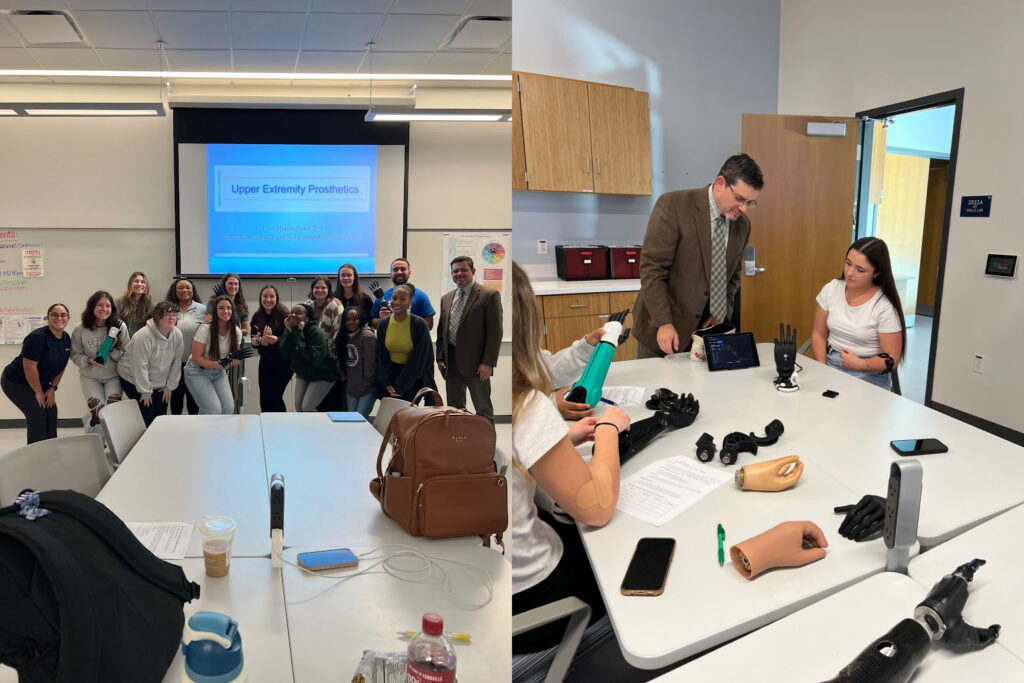
Our in-service training sessions are designed specifically to assist O&P clinics, rehabilitation teams and hospitals as they navigate advanced upper limb prosthetics. Each session is approved for two continuing education units (CEUs) and delivers structured, clinically relevant education on myoelectric systems, patient candidacy, digital workflows, insurance documentation strategies and long-term outcome optimization.
The curriculum equips prosthetists, therapists and physicians with practical insight that can be implemented immediately within their own clinical environments. By investing in shared education, we reduce friction in advanced cases, strengthen interdisciplinary coordination and expand upper limb capacity within partner clinics.
“
“We are not trying to replace local providers. We focus on advancing upper limb technology and sharing that expertise so clinics feel supported when managing complex cases.”
”
Advanced upper limb prosthetics requires digital infrastructure and iterative capacity that can be difficult to sustain when case volume is limited. Many clinics deliver excellent comprehensive care across orthotics and prosthetics, yet advanced arm and hand cases often demand deeper technical refinement and structured documentation.
Our specialist model provides access to that infrastructure when it is needed.
Rather than requiring every clinic to build scanning workflows, rapid test socket iteration processes and direct engineering collaboration internally, the network provides concentrated upper limb capabilities that support regional providers while allowing them to maintain focus on their broader patient population.
“When upper limb cases require advanced components or deeper iteration, our role is to provide that technical layer,” said Ian Reyes, CPO, in Atlanta. “We stay aligned with the clinic so the process remains coordinated.”
Support extends beyond fabrication and fitting. Insurance documentation strategy, candidacy assessment and outcome planning are integrated into each case to reduce administrative burden and strengthen authorization pathways.
“Strong professional partnerships improve outcomes,” said Isabel Gonzalez, CPO, in Charlotte. “When we share expertise and maintain open communication, clinics feel supported and patients benefit.”
The goal is practical: make advanced upper limb care more accessible without requiring every clinic to duplicate infrastructure.
“
“Strong professional partnerships improve outcomes. When we share expertise and maintain open communication, clinics feel supported and patients benefit.”
”
In Austin, Travis Heins has built a reputation around fabrication precision, iterative fittings and structured insurance appeals for advanced upper limb prosthetics.
His evaluations move quickly from scan to fabrication, with multiple flexible TPU test sockets printed from a single model so fit strategies can be compared during the same visit. Earlier alignment on comfort, suspension and control reduces downstream adjustments and shortens time to stable delivery.
“Printing multiple test sockets from one model lets me make informed decisions early,” Heins explained. “That level of iteration used to take weeks. Now, with 3D printing, it happens in a single appointment.”
Authorization planning begins during evaluation, with documentation strategy and physician coordination aligned before submission. Medical necessity narratives are built deliberately to anticipate payer scrutiny and strengthen approval rates for complex myoelectric systems.
“Advanced upper-limb devices require structured documentation for insurance approval,” Heins said. “We treat authorization as part of the clinical plan.”
Heins shares these fabrication techniques, documentation strategies and appeal frameworks with partner clinics through case consultations, training sessions and ongoing communication. By providing insight into scan quality, model modification and authorization preparation, he helps other providers manage complex fittings without needing to build the entire infrastructure internally.

“Upper limb prosthetics requires repetition and refinement,” Heins said. “When you work in it every day, you start seeing patterns that generalist environments might miss.”
Across our network, scanning is replacing plaster casting, refinement begins earlier and engineering collaboration remains continuous. Active case feedback informs best practices for all, allowing partner clinics to access concentrated upper limb expertise while maintaining their broader patient relationships.
Each of the 12 clinics operates within shared digital workflows, documentation protocols and upper limb–specific clinical standards. This coordinated structure allows advanced arm and hand cases to move forward with consistency while preserving the broader care networks that regional providers have built over time.
The model is designed to elevate upper limb outcomes and support existing clinics through access to advanced technology, structured insurance strategy and continuing education. Concentrated expertise strengthens complex cases without shifting ownership of the overall patient relationship.
“Listening first improves long-term outcomes,” Richards said. “The first visit sets the tone for the next decade of care.”
That philosophy extends across the network. Deliberate evaluations, early-stage refinement and proactive authorization planning strengthen patient confidence while reinforcing collaboration with partner clinics.
Upper limb prosthetics is evolving through specialization. The goal is not expansion for its own sake, but shared capacity. By concentrating advanced upper limb expertise within a coordinated national framework, O&P clinics gain access to the tools, training and support needed to deliver stronger outcomes while maintaining the relationships that define their practice.
We work with partner clinics to support the best possible outcome for patients. Connect with our team for training on our advanced bionic technology to know what’s available for your patients.


