3rd March 2026

A prosthetic arm warranty typically covers repairs. What it rarely covers is the clinical relationship, the fit process, or the day-to-day support that determines whether a device gets used consistently. HeroCare, Open Bionics’ three-year support program, was built around a different assumption: that long-term adoption depends on more than hardware, and that users deserve reliable access to the people and systems that keep their device working.
HeroCare applies to every Hero Arm, Hero PRO, and Hero RGD delivered directly through an Open Bionics clinic. It covers manufacturing faults across the full device, including myoelectric components and the flexible inner socket. It also includes the 60-day fit guarantee that forms the foundation of the Perfect Fit Promise, along with prosthetic training, customer support, and optional annual servicing. For users who come directly to an Open Bionics clinic, coverage is integrated with a fitting process and a clinical relationship that carries through the full three years.

The practical value of HeroCare begins with how support is accessed. Emily Shannon, a clinical prosthetist at the Open Bionics clinic in Orlando, Florida, said direct clinician access is one of the program’s most significant advantages.
“My patients can call me and say something is loose or not working, and I can address it immediately,” she said. “If I need to escalate something, I have a direct line to the engineering or maintenance team. There is no middleman slowing things down.”
“
“My patients can call me and say something is loose or not working, and I can address it immediately. If I need to escalate something, I have a direct line to the engineering or maintenance team. There is no middleman slowing things down.”
”
That directness has practical consequences. When a user contacts their Open Bionics clinician, the person on the other end of the call already knows the patient’s residual limb, their electrode sensitivity settings, and their daily use patterns. The diagnostic process starts from an informed position rather than from scratch.
Advanced prosthetic devices require maintenance over time. HeroCare is designed to minimize the disruption when that happens. If a repair is needed, Open Bionics provides a loaner hand that reaches most users within three days. That turnaround is significantly faster than the timelines common with traditional prosthetic manufacturers, where devices are routed through third-party distributors or shipped overseas before they are assessed.
“
“Patients at other clinics could end up waiting without any device because the clinic has to ship the hand off to the manufacturer, sometimes overseas. It can lengthen the whole process.”
”
Jonah Rhymer, a certified prosthetist at the Open Bionics clinic in Chicago, Illinois, said the contrast with other brands is most visible when something goes wrong. “Patients at other clinics could end up waiting without any device because the clinic has to ship the hand off to the manufacturer, sometimes overseas,” he said. “It can lengthen the whole process.”
With HeroCare, the repair process stays within the same organization that built the device. Open Bionics is a US-based company, and the team handling a repair request is the same team that designed and manufactured the hardware.
Each Hero Arm, Hero PRO, and Hero RGD is built from more than 100 individual components. That modularity is a deliberate engineering choice that directly supports the repair model within HeroCare. When a specific part wears or fails, the clinical team can replace that component without disturbing the fit, alignment, or aesthetics of the rest of the device.
Jonah said this approach matters for users who depend on their arm for work or daily routine. “If something breaks, we do not have to take apart the whole prosthesis,” he said. “We can replace the exact part that needs attention. It keeps downtime short and reduces the frustration users feel when they have to send away something they depend on.”
“
“If something breaks, we do not have to take apart the whole prosthesis. We can replace the exact part that needs attention. It keeps downtime short and reduces the frustration users feel when they have to send away something they depend on.”
”
The modular approach also supports longer-term device management. Components can be upgraded independently as new versions become available, and users maintain continuity with the cosmetic finish they chose at delivery.
Emily said one of the less visible aspects of HeroCare is how user feedback is handled at the engineering level. She described a recent case involving a Hero Gauntlet user whose experience with a specific component prompted a direct conversation with the product team.
“I had the engineering team video call in with the patient and we problem-solved together,” she said. “I told the patient, you are literally informing future developments of this product by having this conversation. That is something you do not get in another clinic.”
That feedback loop is a structural feature of working with a manufacturer that also operates clinics. Clinical observations reach the engineering team through a short internal path, and product changes can be informed by real-world use data rather than formal complaint processes alone.
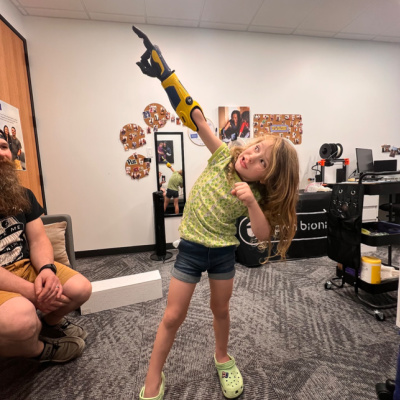
Most prosthetic arm warranties are transactional. They define what is covered, what is excluded, and how to submit a claim. The user’s experience of the warranty depends largely on the responsiveness of whoever handles that claim, which often involves multiple parties.
HeroCare differs in three ways. First, the manufacturer and the clinician are the same organization. When a user contacts Open Bionics about a problem, there is no handoff between a clinic and a manufacturer because those functions sit within the same team. Second, coverage is built around real-world use rather than ideal conditions. Volume fluctuations, component wear, and the demands of daily activity are expected and accounted for. Third, the technology in the Hero PRO and Hero RGD requires support from people who understand it at an engineering level. HeroCare ensures that repairs are handled by clinicians and technicians with specific training in these devices, not by general prosthetic labs working from a generic service manual.
Emily said the program’s underlying purpose is reliability. “We never promise that things do not break,” she said. “But we have a system in place to address them quickly. That makes all the difference for users who want reliability.”
Jonah framed it in terms of long-term adoption, which he described as his primary clinical goal. “If it does not fit or does not work, it ends up in a closet,” he said. “HeroCare and the Perfect Fit Promise are how we prevent that. We make sure the device works for them, not the other way around.”
“
“If it does not fit or does not work, it ends up in a closet. HeroCare and the Perfect Fit Promise are how we prevent that. We make sure the device works for them, not the other way around.”
”
A prosthetic arm warranty that covers repairs is a starting point. HeroCare is built on the premise that what users actually need is a support structure that keeps the device functional, the fit accurate, and the clinical relationship intact for the full duration of their coverage.nd providing access to annual servicing and ongoing clinical guidance.
If you are considering a Hero Arm, Hero PRO, or Hero RGD, coming directly to an Open Bionics clinic means your device is designed, fitted, and supported by the team that knows it best. To find out what your first weeks with a new bionic arm would look like, book a free consultation with your nearest Open Bionics clinic.


