3rd March 2026
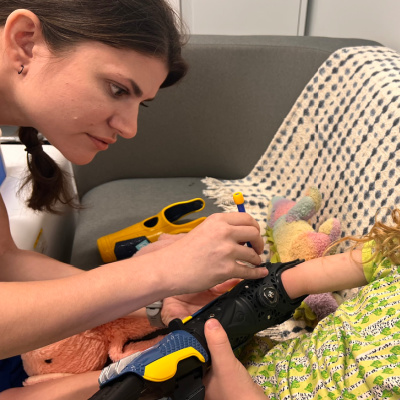
Getting a bionic arm is a significant milestone. Prosthetic arm fitting shapes everything that follows: how confidently a user wears the device, how accurately the electrodes detect muscle signals, and whether the arm becomes a natural part of daily life or sits in a drawer. At Open Bionics, the Perfect Fit Promise exists to protect that process. Every Hero Arm, Hero PRO, and Hero RGD user receives dedicated fitting time, clinical support, and adjustment windows so the device feels secure and comfortable from day one.
The prosthetic socket is the point of contact between a user and their device. Clinical research consistently identifies socket fit as the primary factor in whether a prosthesis gets used at all. A device that is uncomfortable, poorly suspended, or unreliable in its signal detection will be abandoned regardless of its technical specification.
Emily Shannon, a clinical prosthetist at the Open Bionics clinic in Orlando, Florida, said the two non-negotiables at every fitting are comfort and suspension. “If it is not comfortable, they are not going to use it,” she said. “If it does not stay on, it is not practical.”
“
“If it is not comfortable, they are not going to use it. If it does not stay on, it is not practical.”
”
Jonah Rhymer, a certified prosthetist at the Open Bionics clinic in Chicago, Illinois, works from the same principle. “Ultimately that is my objective with everything I do,” he said. “If the fit is not accurate, the prosthesis is not going to work at all.”
Every Hero PRO or Hero RGD delivered directly through an Open Bionics clinic includes a socket fitting service with a 60-day fit guarantee. That guarantee sits within a three-year HeroCare coverage program that also covers manufacturing faults, optional annual servicing, customer support, and prosthetic training with an Open Bionics clinician. There are no hidden costs.

The 60-day window is intentional. Residual limbs change in the weeks following a new fitting, particularly for users who are building up wear time or returning to higher activity levels. Volume fluctuations are common, and a socket that fits well on delivery day may need adjustment as the limb settles. The Perfect Fit Promise gives users the clinical access to address that without hesitation.
Jonah said a successful fit at delivery meets three specific criteria. “Is the prosthesis suspending, is it not causing any irritations, and if we remove it, is there going to be redness or discomfort that does not go away while they are in the office,” he said. “To me that hits it.”
“
“Is the prosthesis suspending, is it not causing any irritations, and if we remove it, is there going to be redness or discomfort that does not go away while they are in the office. To me that hits it.”
”
Emily said her evaluation at fittings extends well beyond socket geometry. She considers the practical realities of long-term use, including how easily a user will be able to put the arm on and take it off independently. “Fit is one thing, but there are a lot of other elements,” she said. “For some people, ease of donning and doffing can make or break whether the outcome is successful.”
That level of evaluation is only possible when the clinician has deep familiarity with the specific device being fitted. Emily said that familiarity is one of the structural advantages of coming directly to an Open Bionics clinic. “We are very familiar with the material properties of the end product,” she said. “At the test socket fitting, I explain what you are trying on today and how the real one will behave. We know how the choices we make in the fitting translate into the final socket.”
Open Bionics designs and manufactures the Hero PRO. That distinction matters in a clinical context. Prosthetists at Open Bionics clinics fit these specific devices every day. They understand the socket materials, the electrode placement requirements, the way the flexible inner behaves over time, and the relationship between test socket decisions and the finished build. That knowledge is not transferable to a general prosthetics clinic in the same way.
“
“At the test socket fitting I explain what you are trying on today and how the real one will behave. We know how the choices we make in the fitting translate into the final socket.”
”
The manufacturing process also gives Open Bionics clinicians more flexibility when adjustments are needed. Traditional prosthetic sockets are fabricated using methods that often require a full remake when the fit needs significant changes. Open Bionics uses 3D-printed flexible inners and digital designs that allow for more targeted modifications. Jonah said this is a meaningful clinical advantage.
With a 3D-printed system, he explained, it is possible to adjust the flexible inner in a controlled, global way rather than starting from scratch. For a user whose limb volume changes during the first months of wear, that flexibility translates directly into faster, more precise resolution when something needs to change.
The Perfect Fit Promise is the front end of the wider HeroCare support program. When a patient receives a Hero PRO directly from Open Bionics, the same integrated team that designed and built the device is responsible for fitting it, training the user, and supporting them through any issues that arise over three years of coverage.
That continuity is clinically significant. The first few weeks of prosthetic arm fitting shape long-term adoption. A comfortable socket encourages consistent wear, faster myoelectric learning, and better functional outcomes. A poorly fitting socket slows that progress and can create frustration that is difficult to reverse. The Perfect Fit Promise protects the time and clinical attention needed to get the foundational fit right.

It also removes a common barrier. Many users hesitate to return for adjustments because they are unsure whether their concerns are significant enough to warrant an appointment, or because they worry about cost. The guarantee removes both of those hesitations during the most important phase of the journey.
The fitting process at an Open Bionics clinic follows three appointments: an initial evaluation, a test socket fitting, and a delivery appointment. Each stage builds on the last. By the time the finished device is delivered, the clinician has a detailed picture of how the residual limb behaves, where the electrode sites sit most reliably, and what adjustments the socket may need over time.
After delivery, the 60-day fit guarantee means users can return for adjustments without hesitation. The HeroCare program then continues that support for three years, covering the device against manufacturing faults and providing access to annual servicing and ongoing clinical guidance.
If you are considering a Hero Arm, Hero PRO, or Hero RGD, coming directly to an Open Bionics clinic means your device is designed, fitted, and supported by the team that knows it best. To find out what your first weeks with a new bionic arm would look like, book a free consultation with your nearest Open Bionics clinic.


