One of the first questions people ask after an upper limb amputation is when they can get back to work. The answer depends on a lot of factors: the level of the amputation, the type of job, how healing progresses, and when prosthetic fitting begins.
What is consistent across most cases is that returning to work is achievable. The timeline varies. The path is rarely a straight line. But with the right device, the right clinical team, and realistic expectations about each phase, most people do get back to meaningful employment.
This guide covers the practical timeline from surgery to workplace reintegration, what the Hero PRO and Hero RGD make possible across different job types, and what to expect from each stage of the process.

Weeks 1 to 6
The immediate post-operative period focuses on healing, pain management, and preparing the residual limb for prosthetic fitting. A physiatrist, a physician specializing in physical medicine and rehabilitation, typically takes over from the surgical team and coordinates pain management, therapy referrals, and return-to-work planning. Residual limb shaping with a compression sock or shrinker begins during this phase to reduce swelling and prepare the limb for a socket.
Weeks 6 to 12
Once the surgical site is healed and swelling has stabilized, prosthetic fitting typically starts. A preparatory or check socket is often fitted first to accommodate limb volume changes as the residual limb continues to mature. Occupational therapy begins in parallel, focusing on how to use the device for real-world tasks. This is the phase where goals matter most. What you want to do at work should shape how your device is configured from the start.
Months 3 to 6
The definitive device is fitted once limb volume has stabilized. For myoelectric users, this is when sensitivity calibration, grip mode training, and workplace-specific skills are built through occupational therapy and the Sidekick App. Many people return to work in some capacity during this phase, either in a modified role or with workplace accommodations in place.
6 months and beyond
Control improves with consistent use and training. Many users report that the device begins to feel intuitive in the months following initial fitting. Return to previous employment, including physically demanding roles, is common by this stage for below-elbow users with myoelectric devices. Some workers benefit from a therapist visiting the workplace to assess specific task demands and suggest adaptations.
Research shows approximately 66% of people return to work following an upper limb amputation. The figure is higher for those who are fitted early, trained thoroughly, and supported by a multidisciplinary clinical team.
Emily Shannon, a certified prosthetist at our Orlando, Florida clinic, sees this pattern consistently in her patients.
“A lot of people think they have to wait a long time after an amputation before they can even start the process. But starting early can make a huge difference. It keeps you from forming habits that strain your other arm and it helps you get your life back sooner.”
Emily Shannon, certified prosthetist, Open Bionics clinic, Orlando, FloridaThe goal is not just to get back to work. It is to get back to work with a device that keeps up.

The Hero PRO and Hero RGD are the only fully wireless, waterproof bionic arms on the market. The wireless design removes cable systems and electrode leads from the socket, which reduces friction during active work and eliminates a common source of discomfort and failure in demanding environments. The Hero RGD adds enhanced durability for environments where impact, moisture, and heavy use are factors.
Both devices use the wireless MyoPods to detect muscle signals, which can be placed anywhere on the residual limb for optimal signal quality. The Sidekick App lets clinicians configure grip modes to match the specific tasks a patient needs to perform, whether that is precision pinch for delicate work or hook grip for carrying and lifting.
Lucy, who uses her Hero Arm as a warehouse worker at Screwfix, described what daily professional use actually looks like.
“I use it every day at work. I can push cages, trollies, and drive any manual handling equipment around the warehouse, as well as using other heavy machinery and equipment.”
Lucy, Hero Arm userDaniel, who works as a technician, found the Hero Arm handled the two-handed demands of his role consistently.
“For me the arm has been incredibly useful for my job as a technician because I do a lot of work that generally requires two hands, and it has been more than capable keeping up with the workload.”
Daniel, Hero Arm userMike, a military veteran now using the Hero RGD, put 30 years of bionic arm experience into one observation.
“I have had 5 other bionic arms over the past 30 years and the last two by far have been the easiest to use and the most unique of them all.”
Mike, Hero RGD user
Robert owns a vending machine company with more than 250 machines across Jacksonville, Florida. He hauls product, installs compressors, fixes electrical issues, and physically manages day-to-day operations. On July 4, 2025, a mortar went off in his right hand and took approximately eleven inches of his arm. He is left-handed, which he credits with saving his other hand.
His attitude from the start was deliberate. “You cannot control stuff. Things happen in your life and nothing is going to change it. Nothing is going to grow my arm back. The only thing I have control over is my attitude. Right from the beginning I said, we are not getting depressed. We are making jokes about it.”
The accident changed how he works. “With our business, I am the guy that fixes everything and keeps things going,” he said. “This has really been a setback having one hand. I get things done, but not as fast as I used to and I cannot do it all like I used to.”
But what hit him hardest was losing what mattered most outside of work. He and his wife Christina hunt whitetail in Georgia and fish offshore in Florida. He had a ticket to Alaska for the salmon run, booked before the accident. He was supposed to leave the following week. “Then I blew my arm off,” he said. “I was supposed to go. I’m still planning on going.”
When hospital staff suggested a basic training prosthesis to start, Robert declined immediately. “They said, just get this base model. As a beginner, just to see if you might like it. I said, no, I am not doing that. I already know that I need something useful.” His brother-in-law had already been researching options and pointed him toward Open Bionics. “He said, you need to look at these guys and talk to them. Right from the go, we were like, yeah, these are the people we want to work with for sure.”
At his fitting appointment in Orlando, he walked in carrying two fishing rods. What he needed from a device was clear: multiple grip patterns for tools and product, durability for working in Florida heat and wet environments, and waterproofing for boat decks, tree stands, and compressor installs. The Hero PRO, with its quick-disconnect wrist and modular activity attachment ecosystem, was the answer.
“It will be good to have the water resistance of this arm. That was a big deal for me, especially up in Alaska. We went through a lot to get this, so we are going to keep it in as good shape as we can.”
Robert, Hero PRO user, Jacksonville, FloridaThe Hero PRO was fully funded through his insurance. His clinical team fast-tracked his evaluation and fitting so Robert could receive his device before the end of the year and maximize his insurance benefits. He was just five months post-amputation at the time of fitting. His certified prosthetist Emily Shannon, at the Orlando clinic, spoke directly to what that early start makes possible.
“Robert is only five months out and he is already controlling a myoelectric hand with a functional socket. More people should know it is not off the table. If you have good healing and good muscle signals, starting early can make a huge difference. It keeps you from forming habits that strain your other arm and it helps you get your life back sooner.”
Emily Shannon, certified prosthetist, Open Bionics Orlando clinicEmily added that his goals were already shaping how the device was configured. “The fact that he is using this device so early in his recovery is a big deal, and it shows how motivated he is. He is already thinking about work tasks and fishing attachments. That is exactly why we wanted to fast-track this for him.”
Robert talks about what comes next with the same clarity he brought to his recovery. He wants to drive a forklift, lift cases of soda, and stock machines with both hands. He wants to stop putting all the strain on his left arm. He wants to stand in Alaska’s rivers with sockeye at his feet.
“I blew my arm off this year, but I’m still planning on going to Alaska. With this arm, I feel like I actually can.”
Robert, Hero PRO userReturn-to-work planning works best when it starts from the specific demands of the job. A warehouse role has different grip and load requirements than an office environment. A tradesperson’s daily tasks differ from a teacher’s. Open Bionics clinicians configure devices around those real-world needs from the first fitting appointment.
Across job types, there are consistent patterns in what matters most:
Manual and trade roles benefit most from the Hero RGD’s enhanced durability, the hook grip mode for carrying and tool use, and the Hero Flex socket’s compatibility with activity-specific attachments. The waterproof design means the device can handle environments where conventional myoelectric arms would need to be removed.
Office and professional roles tend to prioritize precision pinch and tripod grips for typing, writing, and handling documents. The wireless design removes the bulk and discomfort of cable systems during extended desk work. Grip mode switching through the Sidekick App can be customized to minimize the number of transitions needed throughout the day.
Roles requiring public-facing interaction often see the greatest benefit from the confidence shift that comes with wearing a device that looks and performs the way the Hero PRO and Hero RGD do. Benjamin, who returned to previous activities he had given up after his amputation, described the broader impact in straightforward terms.
“My Hero Arm has allowed me to return to many of my previous activities I could no longer do since my amputation.”
Benjamin, Hero Arm user
Under the Americans with Disabilities Act, employers with 15 or more employees are required to provide reasonable accommodations to qualified individuals with disabilities, including those returning after limb loss. Reasonable accommodations can include modified workstation setup, adjusted task assignments during early reintegration, altered schedules during the training phase, and ergonomic equipment.
Workers’ compensation cases involving upper limb amputation typically include vocational rehabilitation support. This can cover prosthetic fitting, occupational therapy, and retraining for a modified or alternative role where the original position is no longer accessible. If the amputation occurred on the job, your employer’s workers’ compensation carrier is required to coordinate this process.
It is worth having a frank conversation with your prosthetist and occupational therapist about your specific workplace before your return. Some clinicians will visit a worksite directly to assess task demands, which leads to better device configuration and a faster, more confident reintegration.
The research is consistent: early prosthetic fitting correlates with higher wear rates, better functional outcomes, and higher rates of return to employment. The first few months after an upper limb amputation are when habits, compensations, and adaptations are set. Starting the prosthetic process during that window gives you the best foundation.
Open Bionics operates specialist upper limb clinics across the United States. Every consultation is free. The clinical team will work with you to understand your job, your goals, and your timeline, and build a fitting and training plan around them.
If you are in the early stages of recovery and beginning to think about returning to work, a conversation with an Open Bionics clinician is a good place to start. If you are further along and considering an upgrade to the Hero PRO or Hero RGD, that conversation is just as valuable.
Speak with an Open Bionics clinician at no cost. We will help you build a plan around your job, your goals, and your timeline.
Book a free consultationWhen people begin researching prosthetic options for an upper limb difference, one of the first questions they face is also one of the most fundamental: what level is the limb difference, and what does that mean for what is available?
The distinction between a below-elbow and above-elbow limb difference shapes almost every aspect of the prosthetic journey. The control mechanisms work differently. The socket complexity differs. The number of joints involved changes what the device needs to do. So do the options.
This guide covers what that difference means in practical terms, what each level makes possible, and where Open Bionics fits into the picture.

A below-elbow limb difference (the acquired form is called transradial amputation) means the limb is absent or ends between the wrist and the elbow, whether from birth or through acquired limb loss. The elbow joint is intact. The muscles in the forearm that would normally control the wrist and hand are partially or fully present. That remaining musculature is what myoelectric devices use to generate control signals.
An above-elbow limb difference (the acquired form is called transhumeral amputation) means the limb is absent or ends between the shoulder and the elbow. The elbow joint is absent. Control signals must come from higher up in the arm, typically the biceps and triceps. A prosthetic device at this level needs to replace both elbow and hand function, which significantly increases the complexity of both the hardware and the control system.
Both levels are common across acquired and congenital presentations. The prosthetic path for each is distinct but well-established.

Retaining the elbow means the prosthetic system does not need to replicate elbow function, only the hand and wrist. Open Bionics’ socket is currently designed for below-elbow limb differences, where the complexity of an elbow joint is not a factor. The fully wireless MyoPods can be placed anywhere on the residual limb to detect muscle signals, which are then translated into grip patterns by the Hero PRO or Hero RGD. Most people learn to use this control system quickly, and with training it becomes intuitive.
The practical result is a device capable of handling real-world demands across work, daily life, and activity. Lucy, a Hero Arm user who works in a warehouse, described what that means in her day-to-day.
“I use it every day at work. I can push cages, trollies, and drive any manual handling equipment around the warehouse, as well as using other heavy machinery and equipment.”
Lucy, Hero Arm userDaniel, who works as a technician, found the same was true in his field.
“For me the arm has been incredibly useful for my job as a technician because I do a lot of work that generally requires two hands, and it has been more than capable keeping up with the workload.”
Daniel, Hero Arm userThe effect goes beyond function. Jio, another Hero Arm user, described a shift in how he experienced himself outside of wearing the device.
“The biggest difference is how I now feel when I am not wearing it. I’m totally okay with my limb difference now. I’m not shy about it. It’s just made my life easier. It helped me to accept being different and that it’s cool.”
Jio, Hero Arm userWe operate specialist upper limb clinics across the United States and fit people with below-elbow limb differences with the Hero Arm, Hero PRO, and Hero RGD. Each device is custom-fabricated to the individual’s residual limb, and all clinical appointments are included.
The level of a limb difference shapes what is possible. It does not set the ceiling for what you can do.

People with above-elbow limb differences face greater system complexity because the prosthesis must replace both elbow and hand function. Our Hero Flex socket is currently designed for below-elbow limb differences, as it does not include an elbow joint. The Hero PRO’s fully wireless MyoPods can be placed anywhere on the body to detect muscle signals, which is precisely what makes it well-suited as a terminal device in above-elbow systems built by partner prosthetists.
Traditional myoelectric systems for above-elbow users relied on sequential control: the user switches between elbow mode and hand mode using a dual muscle contraction. Every movement requires deliberate thought. More recent advances, including pattern recognition systems and targeted muscle reinnervation (TMR), have improved this significantly by creating additional control sites and allowing more natural, simultaneous movement.
Mike, a military veteran and Hero RGD user, has worn bionic arms for 30 years. His take on where the technology stands now is direct.
“I have had 5 other bionic arms over the past 30 years and the last two by far have been the easiest to use and the most unique of them all.”
Mike, Hero RGD userEric made the trip from Michigan to Chicago with his father-in-law, who had lost his arm in a machine press over 50 years earlier and had never considered a bionic option. Eric described what that appointment meant for his family.
“With his age we knew this would be a challenge for him with the technology. However, our prosthetist took an incredible amount of time and has the patience and passion to truly make this experience life changing.”
Eric, family member of a Hero PRO userOpen Bionics fits people with below-elbow limb differences directly through its specialist US clinics. Above-elbow presentations require a prosthetist who can fit the full system including the elbow component, and Open Bionics supports those cases through its partner clinic network.
A recent case involving AlliedOP and Open Bionics illustrates how that works in practice. Angelo Russello, a senior prosthetist at AlliedOP, was referred an adult with an above-elbow limb difference who had researched the Hero PRO online and wanted to explore it as a terminal device option. She had reduced function in her sound arm, which made precise grip and daily task function a priority. Clinical evaluation showed limited viable control sites on her upper arm, which ruled out a fully powered myoelectric elbow.
A hybrid configuration offered the practical solution. The fully wireless design of the Hero PRO allowed both a body-powered hook and a myoelectric hand to be used through a single socket, connected via the standard quick-disconnect wrist adapter. The patient can switch terminal devices depending on the task.
“The idea was to give her flexibility. She can function with a hook day to day, but wanted to use a hand when it makes sense.”
Angelo Russello, senior prosthetist, AlliedOPAngelo worked closely with Daniel Green, a clinician at the Open Bionics New York clinic, to review compatibility and system setup throughout the process.
“This was a strong collaboration from the start. Our role was to support that process by reviewing compatibility and making sure the components worked together the way Angelo needed them to.”
Daniel Green, clinician, Open Bionics New YorkThe single-socket hybrid approach also addressed practical constraints around insurance coverage and fabrication, reducing the need for additional sockets while supporting long-term adoption.
If you have an above-elbow limb difference and want to explore the Hero PRO as a terminal device, ask your prosthetist about Open Bionics. You can also register on our website to get exclusive updates on bionic hands for above-elbow prosthesis users.
Find a local clinic Stay updatedThe hardware matters. The socket fit matters. Comfort matters more than almost anything else, because a device that does not feel right does not get worn, and a device that does not get worn cannot help anyone.
Beverley had worn prosthetic arms for over 40 years before switching to the Hero Arm. The difference she described was not just functional.
“It instantly became a part of me and the most comfortable prosthetic limb I have worn in over 40 years. Oh, and that pain I used to have? It’s gone.”
Beverley, Hero Arm userKristin, a quad amputee, switches between her Hero PRO and a Hero Arm depending on the task. Her bionic arms helped her walk again.
“The Hero Arm has helped make walking on my prosthetic legs so much easier because I can grip my cane with my Hero Arm. It is wild how confident my Hero Arm makes me feel while I walk, go up and down stairs, and sit or stand.”
Kristin, Hero Arm userWhat both levels share is the goal of getting the most out of life. Your clinical team at Open Bionics and our partner clinics will work with each person to fit the right device to your specific goals.
Whether your limb difference is below or above the elbow, a conversation with a specialist is where you move from general information to a plan that fits your specific anatomy, goals, and life.
We operate specialist upper limb clinics across the United States. People with below-elbow limb differences can book a free consultation directly. Those with above-elbow limb differences can speak with their prosthetist about accessing the Hero PRO as a terminal device, or register on our website to stay updated on bionic hands for above-elbow users.
Speak with an Open Bionics clinician at no cost. Every consultation is free, and there is no commitment required.
Book a free consultationIf your child has a limb difference, you have probably already spent time wondering what the right path forward looks like. Whether the difference was present from birth or came later, the questions that follow are similar: What options are available? When is the right time? What will actually help?
There are no universal answers. Every child is different, and the best path is shaped by their age, their goals, and what matters to them personally.
What this guide covers is what parents most often want to know: how modern bionic arms work for children, what to expect from the fitting process, and how families have experienced it firsthand.

Children are active, fast-growing, and hard on equipment. They learn through play, movement, and doing things with their hands. A device that slows them down, feels uncomfortable, or requires constant management tends to get abandoned. Research published in the Journal of the Pediatric Orthopaedic Society of North America confirms this: smaller, lighter, and more durable prosthetic components are among the most pressing needs in pediatric prosthetics, and comfort is one of the primary drivers of wear time.
Modern myoelectric arms for children address these needs differently than older devices did. The Hero Arm uses EMG sensors to detect small muscle signals from the residual limb, translating them into finger movement and grip. The device is 3D-printed to fit each child’s individual anatomy, with a soft inner liner and ventilation built into the socket to keep it comfortable through active days. Most children learn to control it quickly, and with guidance from a clinical team, muscle control becomes intuitive.
“I can’t stress enough how important comfort is,” said Lucas, a Hero Arm user who later upgraded to the Hero PRO. “I know from my own experience that if something doesn’t feel right, you just won’t wear it.”
Lucas, Hero PRO userOne Hero Arm user, now wearing the Hero PRO, also reflected on what he wished had been available in childhood. “I remember wishing for that kind of precision when I was learning to ride a bike or carry a backpack,” Lucas said. “The control makes so many everyday tasks possible in a way older prosthetics could not.”
A prosthetic that fits well and feels like your own gets worn. One that does not, does not.
The Hero Arm is available for children from age five, making it one of very few multi-grip myoelectric bionic arms clinically approved for pediatric use. Clinical literature supports early prosthetic fitting where appropriate, noting that early introduction promotes motor skill development and reduces overuse in the non-affected limb. That said, readiness matters more than age. A child who is curious and engaged will get far more from the process than one who feels pushed into it.
Children who have adapted extensively to life without a prosthesis, as many congenital limb difference children do, may approach the device differently than those who experienced limb loss later. Both paths are valid. The fitting process at Open Bionics is designed to meet children where they are, with clinical teams who work exclusively in upper limb prosthetics and have experience with both presentations.
“Around age eight, independence suddenly matters so much,” said Lucas. “You’re figuring out school, sports, hanging out with friends, and discovering who you are.”
Lucas, Hero PRO userSigns your child may be ready to explore a bionic arm
None of these are requirements. A free consultation is the right place to explore whether the timing feels right for your family.
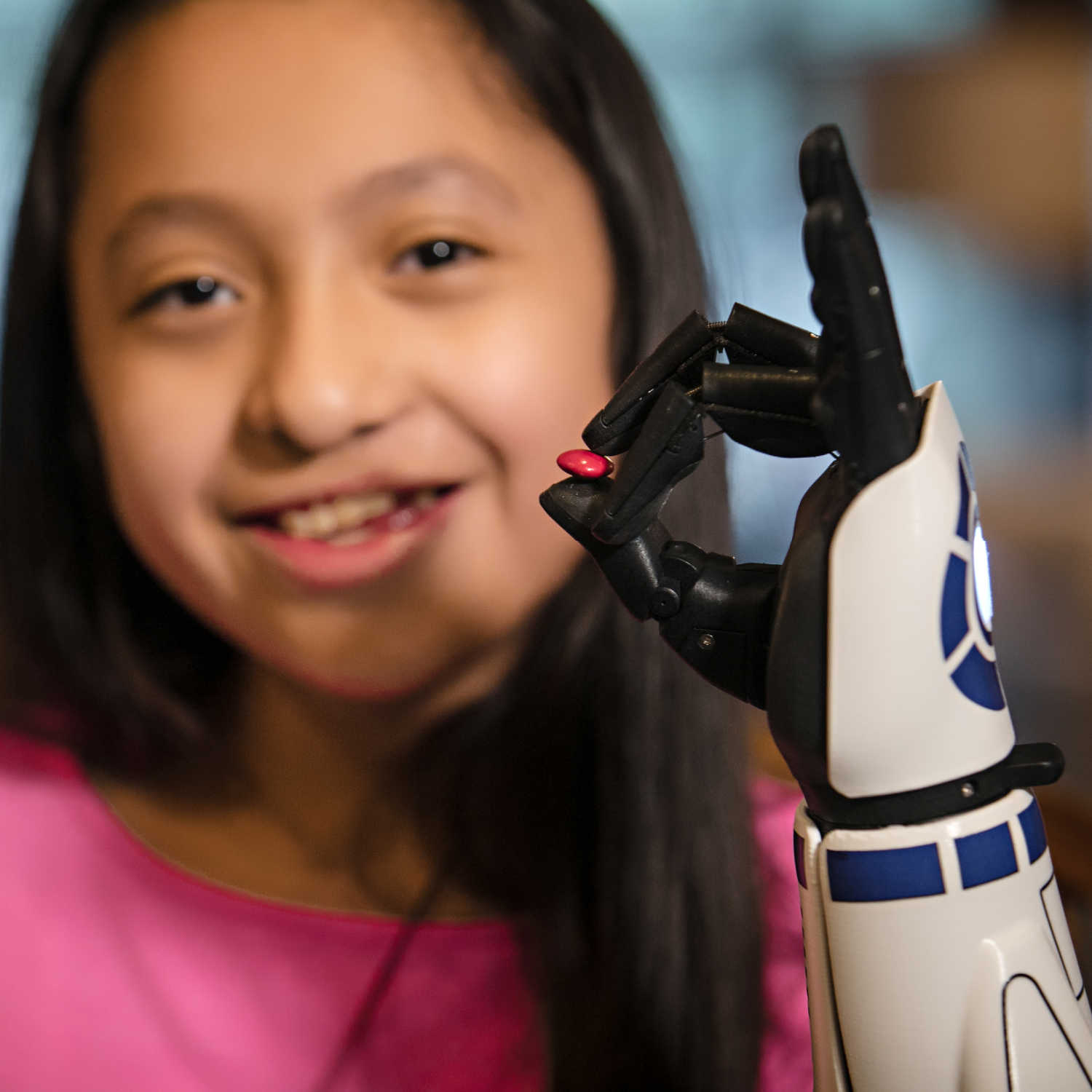
Research on pediatric prosthetics consistently points to psychosocial benefits as one of the most significant outcomes. A device that reflects a child’s personality, that they feel proud to show off rather than hide, changes how they carry themselves at school, with friends, and in new situations.
Daniel, whose daughter Phoebe was born with an upper limb difference, described the shift he witnessed after she received her Hero Arm.
Other children now, instead of asking “why does that girl have only one arm?”, are blown away with the amazing piece of equipment. This has increased Phoebe’s bubbly, zany character tenfold and provided her with a massive confidence boost. Open Bionics have not only supported Phoebe physically, they have helped her mentally with a lifetime of courage.
Daniel, parent of a Hero Arm userAlexander, whose daughter also received a Hero Arm, shared a similar observation.
Since my daughter has started using the arm she has started learning a lot of new things she can do, and it has given her so much confidence in everyday life. Thank you for making my daughter one step ahead of everyone else rather than one step back.
Alexander, parent of a Hero Arm user“Learning to embrace my limb difference was all about finding confidence in myself,” Lucas said. “The Hero Arm helps kids do the same thing while having a bit of fun at the same time.”
Lucas, Hero PRO userThe Hero Arm‘s magnetic covers let children personalize their device, choosing a look that fits their style. The option to make the arm part of their identity rather than something separate from it matters to children in ways that are hard to quantify but easy to see.
The journey to a first Hero Arm typically involves an initial consultation, a 3D scan of the residual limb, fabrication, a fitting appointment, and a delivery session that includes hands-on training. The process is designed to be straightforward for children and parents, with clinical staff who specialize exclusively in upper limb prosthetics.
Laura, whose six-year-old son received a Hero Arm, described the experience across multiple clinics.
Every step of the process, even Open Bionics’ help with getting insurance approval, was extremely smooth for us. It’s rare to have such a positive experience from beginning to end, and it’s clear this company puts their patients and families first.
Laura, parent of a Hero Arm userCarrie, whose daughter received her first bionic arm at the Illinois clinic, noted the importance of the ongoing relationship with the clinical team.
From the first phone call to the delivery of my daughter’s first bionic arm and everything in between, our prosthetist showed so much compassion for his patients and his work. We look forward to continuing this journey as she grows.
Carrie, parent of a Hero Arm userOccupational therapists often support children during the early training period, helping build muscle control and practice everyday tasks. The Sidekick App supports ongoing calibration and training at home, making it easier to build confidence between clinical appointments.
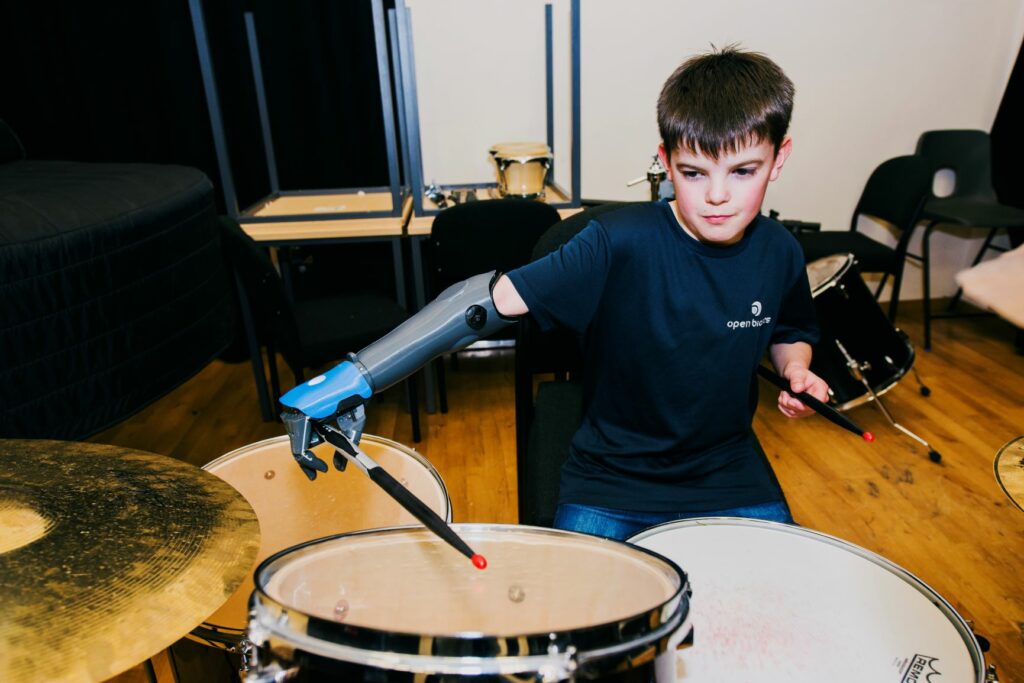
One of the most common questions parents ask is whether a bionic arm will keep up with an active child. The short answer is yes. The Hero Arm can lift up to 8 kg and weighs just over 300 grams. Children have used it for gymnastics, taekwondo, archery, cycling, and everyday school tasks. For older children who meet the size requirements, the Hero Flex socket connects to activity-specific attachments, allowing a single device to adapt across different activities. Your clinician will advise on which device is the right fit for your child’s size and presentation.
Kiowa, an eleven-year-old who received Hero Flex arms through the Open Bionics Los Angeles clinic, uses them for biking, riding horses, practicing taekwondo, and archery. His mother Nicole put it simply: “He’s always been capable. This just gives him more freedom to do what he loves.”
Clinical literature supports this picture. Research from the Journal of the Pediatric Orthopaedic Society of North America notes that most children are able to successfully participate in a variety of recreational activities, including sports and music, while using their prostheses. Activity-specific prosthetic options have expanded significantly over the past decade, giving children more ways to participate fully in the things they enjoy.
As children grow, devices are refitted and updated. The clinical team at Open Bionics supports families through those transitions, which is part of why the relationship with a prosthetist matters as much as the device itself.
Every child’s path is different. Some families come in with a clear idea of what they want. Others are still figuring out whether a bionic arm is the right step at all. Both are the right place to start a conversation.
Open Bionics operates specialist upper limb clinics across the United States. Consultations are free, and the clinical team works with families through the insurance process, the fitting, the training, and the long-term follow-up. If you are ready to find out what is possible for your child, a free consultation with an Open Bionics clinician is the starting point.
Speak with an Open Bionics clinician at no cost. We work with families through every step, from the first conversation to long-term follow-up.
Book a free consultationIf you have ever wondered whether a myoelectric arm is actually useful in daily life, you are not alone. The question comes up constantly, in clinics, in online communities, in the comments sections of social media posts.
It is a fair thing to wonder. Myoelectric arms look impressive. But can they handle the ordinary, unglamorous reality of a full day? Tying your shoes. Opening a pill bottle. Cutting your own food. Hugging someone properly.
The honest answer, from people who wear one every day, is yes. Here is what they say, and how the technology is helping people reach their goals.

Many people who reach out to our prosthetists have tried a prosthetic before and left it in a closet. Perhaps the device was too heavy, the control was frustrating, the promise did not match the lived experience. After that, it is completely reasonable to approach new bionic technology with caution.
Matthew, a Hero Arm user, went years without a prosthetic after his first experience left him feeling like the device worked against him. When he eventually tried the Hero Arm, his perspective shifted.
This device has boosted my confidence and overall has given me a new outlook. I’m happy to finally be one of those whose life you’ve changed.
Matthew, Hero Arm userHis experience is common. The gap between what older myoelectric devices delivered and what current technology can do is significant. That gap is worth understanding before writing off the category entirely.
Doubt is a reasonable starting point. What matters is what happens when you actually try it.
These are the doubts that come up most often, along with what current myoelectric technology does in response to each one.
“Is it useful for real tasks, or just impressive to look at?”
The Hero Arm and Hero PRO offer multiple grip modes controlled by your own muscle signals. Users regularly report using them at work, in the kitchen, during exercise, and for personal care tasks. The device is calibrated to your specific muscle activity through the Sidekick App, which means control improves as you train with it.
“Will I actually wear it every day, or will it sit in a drawer?”
Wear rates for 3D-printed myoelectric arms improve significantly when the device is fitted and trained properly. A well-calibrated device that addresses your specific goals is used. One that does not is abandoned. This is why delivery appointments focus on the tasks that matter most to you personally.
“I’ve managed this long without one. Do I really need it?”
Your needs are based on your goals. The question is whether it helps you reach the goals that matter to you. Tying shoelaces. Carrying something in both hands. Returning to a sport or hobby.
“Is the technology mature enough to be reliable?”
The Hero Arm was the world’s first clinically approved 3D-printed bionic arm. It has been fitted to thousands of users across multiple countries and is available through clinical pathways and insurance. The Hero PRO and Hero RGD were designed from feedback from thousands of Hero Arm users to expand what is possible with durability and precision.

Sarah had gone ten years without being able to tie her shoelaces, close jewelry clasps, use utensils properly, or cut her own food. After getting her Hero Arm, she shared her experience publicly on social media.
Honestly, don’t knock it until you have tried it. It’s my first prosthetic that actually allows me to feel whole again since my amputation. I went 10 years without being able to tie my shoelaces, close the clasps on my jewelry, even using utensils. I couldn’t cut my own meat before this prosthetic. After getting this arm, I was able to really fully hug my nieces for the first time since they were born.
Sarah, Hero Arm user
Wiktoria had lived with a limb difference for 23 years before getting a Hero Arm. She had adapted so thoroughly that she was not sure a device would add much. Two years later, her view on that changed.
My bionic journey marked the start of a completely new chapter in my life, one that I thought would never be possible. Living with a limb difference has always been a major insecurity for me, so never did I think that after twenty-three years I would be able to experience what it’s like to have both arms.
Wiktoria, Hero Arm userDouglas waited over five decades. His doubt was not impatience. It was the rational conclusion of someone who had watched the technology fall short for most of his adult life.
I have waited over 50 years for technology to finally catch up in the world of prosthesis development, and thanks to my prosthetist, that wait is over.
Douglas, Hero PRO user
You do not have to figure it out on your own. When you are fitted with a bionic arm, you have a team behind you who is available to help with training after the delivery.
Benjamin returned to activities he had given up since his amputation. He described his Hero Arm as fitting him perfectly, incorporating features that made a real difference: multiple user modes, carbon fiber cables, and a device built specifically to his anatomy.
My Hero Arm has allowed me to return to many of my previous activities I could no longer do since my amputation.
Benjamin, Hero Arm userThe fitting process at Open Bionics clinical locations is designed around your goals, not a generic checklist. Sensitivity is calibrated to your muscle signals. Grip modes are set up based on the tasks you most want to tackle. Training takes place in the clinic with a prosthetist present, and continues through the Sidekick App at home.
If the doubt you carry is about whether the device will work for your specific situation, the only way to know is to try it with a qualified prosthetist who can calibrate it to you. A free consultation is the starting point for that.
Family members often research myoelectric arms before the person who would wear one does. They carry their own version of the doubt: worry about cost, about whether the device will actually get used, about whether the process is worth putting someone they love through.
Those concerns are worth taking seriously. Our consultation process is with a certified prosthetist who will answer your questions honestly. There is no pressure to commit. The goal is to give you and the person you are supporting enough information to make a decision that is right for your situation.
The Hero Arm and Hero PRO are covered by many US insurance plans. The clinical team can walk you through the coverage process and what to expect before any commitment is made.
You do not need to be convinced before speaking with a clinician. A free consultation is exactly the right place to bring your skepticism, questions, and specific concerns. That is what certified prosthetists are here for.
If you are ready to find out whether a Hero Arm or Hero PRO is right for you, speak with an Open Bionics clinician. The conversation costs nothing, and it starts with your goals, not ours.
Speak with an Open Bionics clinician at no cost. Bring your questions, your doubts, and your goals. We will take it from there.
Book a free consultationMost people arrive at their first prosthetic fitting appointment with a lot of questions and not much else. That is completely understandable. The fitting process is unfamiliar, and it can be hard to know what to expect, let alone what to prepare.
But there is one thing you can do to make a meaningful difference at your appointment: bring objects from your own life.
Come prepared, with tangible goals for your prosthetist to work with. Your goals, your daily tasks, your routines are the things that should shape how your device is fitted and the training that follows. A stack of clinic props can only take you so far.
Prosthetic fittings — and particularly delivery appointments for myoelectric devices like the Hero Arm, Hero PRO, and Hero RGD — involve testing grip patterns, adjusting sensitivity, and learning how the device responds to your muscle signals.
What you can grip is important. A cup is a reasonable starting point, but it does not tell the full story of how you live. A fishing rod does. A set of jewelry-making tools does. An insulin pen does.
Emily Shannon, a certified prosthetist at the Open Bionics clinic in Orlando, Florida, encourages her patients to bring specific items to their delivery appointments. The practice came from watching patients engage more deeply when the tasks felt personally relevant.
I always encourage patients to bring in something specific to them. A cup and a fork are obvious, but the real breakthroughs happen when someone walks in with their fishing pole or their golf club.
Emily Shannon, certified prosthetist, Open Bionics clinic, Orlando, FloridaIt makes a big difference in engagement and the training that follows. When a patient picks up something they care about using, the session becomes more focused and goal-oriented. It is no longer just a demonstration.
A fitting should reflect your actual life — not a generic checklist of grip exercises.
The right objects depend on your life, your work, and the tasks you most want to address. These categories are a useful starting point.
Everyday grip tasks
Tools and hobby items
Fitness and activity items
Building or construction items
Children’s items are welcome too, particularly if you are a parent and daily caregiving tasks are a priority.
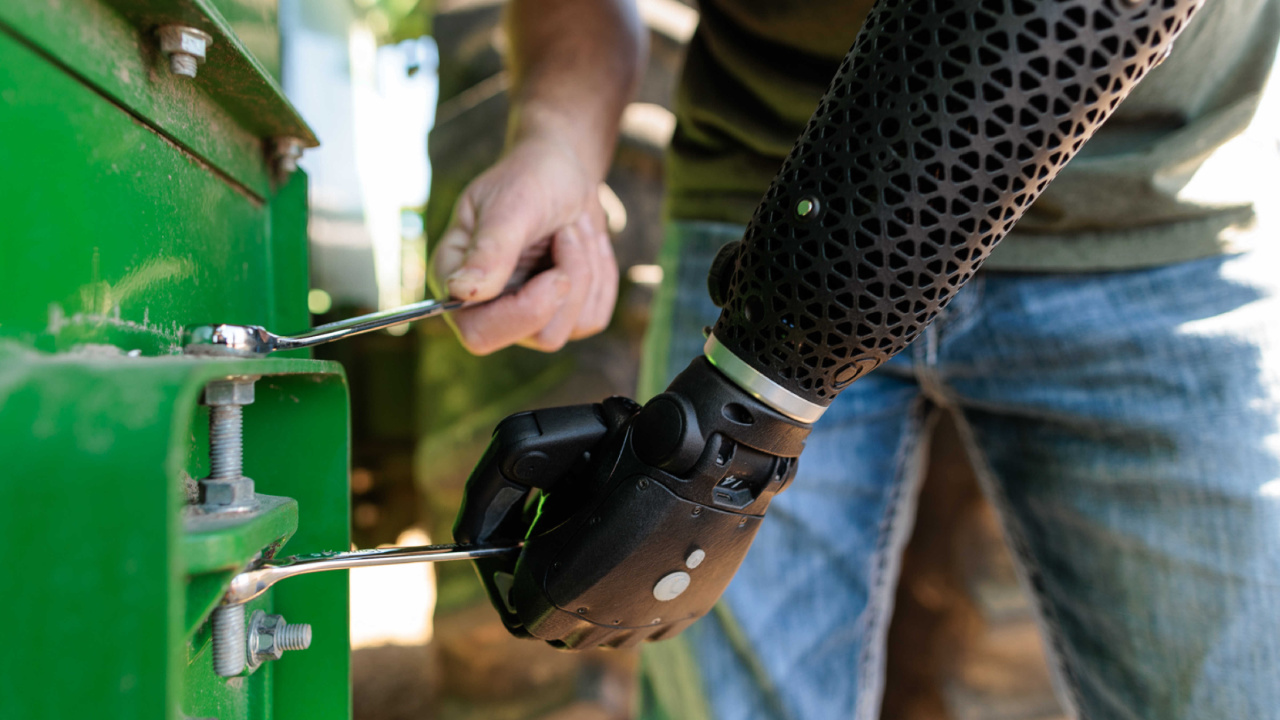
One detail that often surprises patients and clinicians alike is how much the texture of an object affects performance. Slick surfaces are harder to grip than textured ones, regardless of the device.
During a recent Hero PRO demonstration, Emily noticed this clearly when comparing grip performance on smooth versus textured surfaces.
It is not something you would automatically think about, but the texture of the fingertips matters enormously. Anything slick — a glass, a Lego piece, a pill bottle — tells you a lot about how a hand is going to perform in real life.
Emily Shannon, certified prosthetist, Open Bionics clinic, Orlando, FloridaThe Hero PRO‘s fingertip and thumb material is designed with grip in mind, particularly for precision pinch tasks. The key grip, which positions the thumb against the side of the index finger, was added specifically because of how frequently patients need lateral hold for real-world tasks. Bringing objects that challenge this kind of grip gives your prosthetist useful information early in the process.
Prosthetists see common requests. Many patients want to use utensils again, type more easily, or carry objects without switching grip modes. These are legitimate and important goals.
Some goals are completely individual. Robert wanted to fish. Someone else came in with jewelry-making tools. A patient brought his golf club because he could not describe what he needed in words — he needed to show it.
For people who have lived with a limb difference for a long time, or who have not worn a prosthesis in years, the goals can be less defined. In those cases, the fitting appointment becomes part of the process of figuring out what you want. Bringing objects you interact with daily helps surface that.
The more a patient contributes to the session — by bringing something or making a suggestion about what they want to do — the more engaged they stay in the process.
Emily Shannon, certified prosthetist, Open Bionics clinic, Orlando, Florida
Our clinical team runs delivery appointments that include hands-on grip training, mode switching practice, and sensitivity calibration through the Sidekick App. The session is a practical one, and the more your prosthetist knows about your life, the more they can tailor what gets prioritized.
If you are coming with a child, consider bringing objects your child cares about — school supplies, toys, or anything they have mentioned wanting to hold or use. Pediatric fittings are more effective when the tasks feel meaningful to the child, and children are often better at demonstrating their goals than describing them.
Bringing a handful of objects to your fitting appointment takes almost no preparation. The impact on the session can be significant.
The more you can show them, the better equipped they are to do that.
If you are preparing for a Hero Arm or Hero PRO fitting and want to know more about what to expect, speak with an Open Bionics clinician. Consultations are free, and they are a good starting point for anyone beginning to explore their options.
Speak with an Open Bionics clinician. Consultations are free and a good starting point for anyone beginning to look into the Hero Arm or Hero PRO.
Book a free consultationThere are four main types of prosthetic arms: passive (cosmetic), body-powered, myoelectric (bionic), and activity-specific. Each type works differently and suits different people depending on their residual limb, lifestyle, and goals. Modern bionic arms like the Hero PRO and Hero RGD are myoelectric devices that translate muscle signals into multi-grip hand movement.
Understanding the different types of prosthetic arms is usually the first step for people exploring their options after limb loss or with a limb difference from birth. The categories can feel confusing. Cosmetic, body-powered, myoelectric, bionic: these terms appear regularly without explanation, and most resources do not explain who each type is actually right for.
This guide covers each prosthetic arm type clearly, explains how they work in practice, and shows where advanced bionic technology has moved the field forward in recent years.
Every upper-limb prosthesis falls into one of these four categories. Many people progress through more than one over time, or use different types for different purposes.
| Type | Active movement | Powered by | Best suited for |
| Passive / cosmetic | No | N/A | Stabilisation, symmetry, comfort |
| Body-powered | Yes (hook / hand) | Cables + harness | Durability, heavy work |
| Myoelectric (bionic) | Yes (multi-grip) | Electric motor + EMG sensors | Daily life, dexterity, expression |
| Activity-specific | Task-specific | Mechanical or passive | Sport, manual tasks, hobbies |
A passive prosthetic arm does not produce active movement. It is designed to restore the appearance and outline of a limb, assist with two-handed tasks through stabilisation, and reduce the physical asymmetry that can affect posture and shoulder health over time.
Passive arms are typically lightweight and low-maintenance. They are often the first device prescribed after a new upper-limb amputation, giving the wearer time to adjust to carrying a prosthesis before moving to a more functional type. People with congenital limb differences may also use a passive arm in specific social or professional contexts.
The device consists of a custom socket fitted to the residual limb and a prosthetic hand or partial hand shaped to match the opposite side. Modern versions are often lighter and more realistic than older designs, and can be fitted with cosmetic covers in a range of skin tones and finishes.
Passive arms are useful, but they are not the only option. Many people who begin with a passive device transition to a body-powered or myoelectric arm once they are ready to use it functionally.
A body-powered prosthetic arm uses a cable-and-harness system to create movement. When the wearer moves their shoulder, chest, or residual limb in specific ways, tension on the cable opens or closes a terminal device, typically a hook or mechanical hand.
Body-powered devices are durable and responsive. There is no battery, no electronics, and no charging required. Many users in physically demanding environments, including construction, farming, and manual trades, favour a body-powered device or activity attachment for its reliability and strength.
The main limitation is the harness. Wearing a body-powered arm across the shoulders and chest can become uncomfortable over long periods, and the range of functional grips is more limited than with a myoelectric device.
Body-powered technology has existed for over a century. The designs have improved, but the core mechanism remains the same. It is a reliable, proven option and still the right choice for many users and situations.
A myoelectric prosthetic arm is powered by a battery and controlled by the wearer’s own muscle signals. Small sensors inside the socket sit against the skin of the residual limb and detect electrical signals generated when the muscles contract. Those signals are translated into motor-driven movement in the prosthetic hand.
This type of control is called EMG (electromyography). The system reads two distinct muscle sites, typically flexor and extensor muscle groups, and uses their contraction patterns to switch between grip modes and open or close the hand. Most users learn the muscle patterns quickly, and control becomes intuitive within weeks of regular wear.
Modern multi-grip myoelectric hands like the Hero PRO offer eight or more grip patterns, allowing users to hold a pen, grip a steering wheel, pick up a cup, and operate a smartphone touchscreen with the same device. The Hero PRO achieves a full open-to-close cycle in 0.6 seconds, faster than comparable devices currently on the market, and includes a touchscreen-compatible fingertip on the index finger.
Myoelectric arms require charging, and until recently they required wired connections between the hand and the socket electrodes. The Hero PRO and Hero RGD are fully wireless, removing the cable that previously passed through the socket and reducing a common source of wear and reliability problems.
A myoelectric prosthetic arm is powered by a battery and controlled by the wearer’s own muscle signals. Small sensors inside the socket sit against the skin of the residual limb and detect electrical signals generated when the muscles contract. Those signals are translated into motor-driven movement in the prosthetic hand. To learn more about the mechanics, see how a bionic arm works.
This type of control is called EMG (electromyography). The system reads two distinct muscle sites, typically flexor and extensor muscle groups, and uses their contraction patterns to switch between grip modes and open or close the hand. Most users learn the muscle patterns quickly, and control becomes intuitive within weeks of regular wear.
Modern multi-grip myoelectric hands like the Hero PRO offer eight or more grip patterns, allowing users to hold a pen, grip a steering wheel, pick up a cup, and operate a smartphone touchscreen with the same device. The Hero PRO achieves a full open-to-close cycle in 0.6 seconds, faster than comparable devices currently on the market, and includes a touchscreen-compatible fingertip on the index finger.
Myoelectric arms require charging, and until recently they required wired connections between the hand and the socket electrodes. The Hero PRO and Hero RGD are fully wireless, removing the cable that previously passed through the socket and reducing a common source of wear and reliability problems.
The Hero PRO and Hero RGD are Open Bionics’ two multi-grip bionic hands, introduced in April 2025 after four years of development and feedback from around 1,000 existing users.
Both devices connect to the Hero Flex socket using a USMC-standard wrist connector, which allows users to switch between a bionic hand and an activity attachment in seconds without any tools or additional wiring.
“The arms are so much stronger. I can remove my own hand and have it crawl across a table and back to me controlling it via the wireless sensors in my socket. There literally isn’t a single other arm that can do this. No other arm is wireless and waterproof, and it’s faster than everything else while still being the lightest bionic hand.”
Tilly Lockey, bilateral Hero Arm user for nine years
Activity-specific prostheses are designed for a particular task or sport. Unlike passive or myoelectric arms, they are built around function over appearance. Common examples include devices for swimming, cycling, rock climbing, weightlifting, and drumming.
The Hero Flex is Open Bionics’ body-powered socket system designed to work with a growing range of activity attachments. It uses a USMC-style wrist connector compatible with more than 50 attachments from various suppliers. Attachments are waterproof, lightweight, and available in sizes for children and adults.
Activity arms are often used alongside a primary myoelectric device. A person might wear a Hero PRO for everyday tasks and switch to a Hero Flex with a cycling attachment for training. The modular design means no wiring changes are needed between configurations.
No single type of prosthetic arm is right for everyone. The decision depends on the level of limb difference, the muscle signals available in the residual limb, daily activity requirements, and personal priorities.
A certified prosthetist conducts a clinical assessment before recommending a device type. This covers residual limb anatomy, muscle signal testing, activity goals, and occupational needs. Many people start with a passive or body-powered arm and move to a myoelectric device as their rehabilitation progresses.
We operate specialist upper-limb prosthetic clinics across the United States, including locations in New York, Los Angeles, Chicago, Austin, Atlanta, Denver, Orlando, Charlotte, Nashville, and Pittsburgh. Each clinic is staffed by certified prosthetists who work exclusively on upper-limb cases.
If you are exploring prosthetic options for the first time, a free consultation is the most practical starting point. The clinical team can assess whether a myoelectric device is suitable for your limb presentation, explain the insurance process, and walk you through next steps.
There are four main types: passive (cosmetic) arms, which provide stabilization and appearance without active movement; body-powered arms, which use a cable-and-harness system to open and close a hook or hand; myoelectric arms, which translate muscle signals into motorized grip movement; and activity-specific arms, designed for particular sports or tasks.
A passive prosthetic arm does not produce active movement. It restores the outline and appearance of a limb, helps with two-handed stabilization tasks, and reduces the postural asymmetry that can cause shoulder strain over time. Passive arms are lightweight and often the first device prescribed after upper-limb amputation.
A body-powered arm uses physical shoulder or chest movement to pull a cable that opens or closes a terminal device. It requires no battery and is highly durable. A myoelectric arm is battery-powered and reads electrical signals from muscles in the residual limb, translating those signals into motorized grip movement. Myoelectric arms offer more grip variety and do not require a harness.
A bionic prosthetic arm is a myoelectric device with advanced motorized grip capabilities, individual finger movement, and intuitive EMG control. The Hero PRO and Hero RGD from Open Bionics are examples. They feature multiple grip modes, wrist flexion, fully wireless operation, and IPX7 waterproofing. The Hero PRO is the lightest multi-grip bionic arm currently available.
Yes. The Hero Arm is available for children from age five, making it one of the few clinically approved multi-grip myoelectric bionic arms for pediatric use. Children typically learn to control the device quickly. The lightweight design and modular covers make it practical and personalized for everyday school and home use.
The Hero Flex socket connects to a range of activity attachments for cycling, swimming, weightlifting, archery, rock climbing, and more. The Hero PRO and Hero RGD are both fully waterproof, allowing use in rain and water sports. A certified prosthetist at an Open Bionics clinic can advise on the right combination of socket, bionic hand, and attachments based on your specific activities.


